
It is a little after two in the morning and you are awake again. Not worried awake. Heat awake. The back of your neck is damp, the sheet underneath you has gone warm in one specific spot, and the ceiling fan has been running for hours moving air that feels like nothing at all. So you lie there doing arithmetic: get up and change the shirt, or lie still and hope it passes. Both options are bad. You have already tried both of them.
I am Denise Marlow. I am 53, I am a middle-school librarian in Chattanooga, and my hot flashes started at 49. The worst stretch was the year I turned 51, when I woke three or four times a night and kept a spare sleep shirt on the nightstand so I could change without turning on a lamp. What I wanted was something I could switch on without getting out of bed. I bought the JISULIFE neck fan in June, and it has become the one thing in this bedroom I reach for at two in the morning. Not the sheets. Not the pillow. This. Here is how I actually use it, in the order I do it.
The fan that lives on my nightstand, not in a drawer
Bladeless and hands-free, five speeds on a button, 4000 mAh with 4 to 16 hours of run time depending on speed. Mine has been on the nightstand since June.
Amazon Check Today's Price on Amazon →Step 1: Put It on the Nightstand Before You Get Into Bed
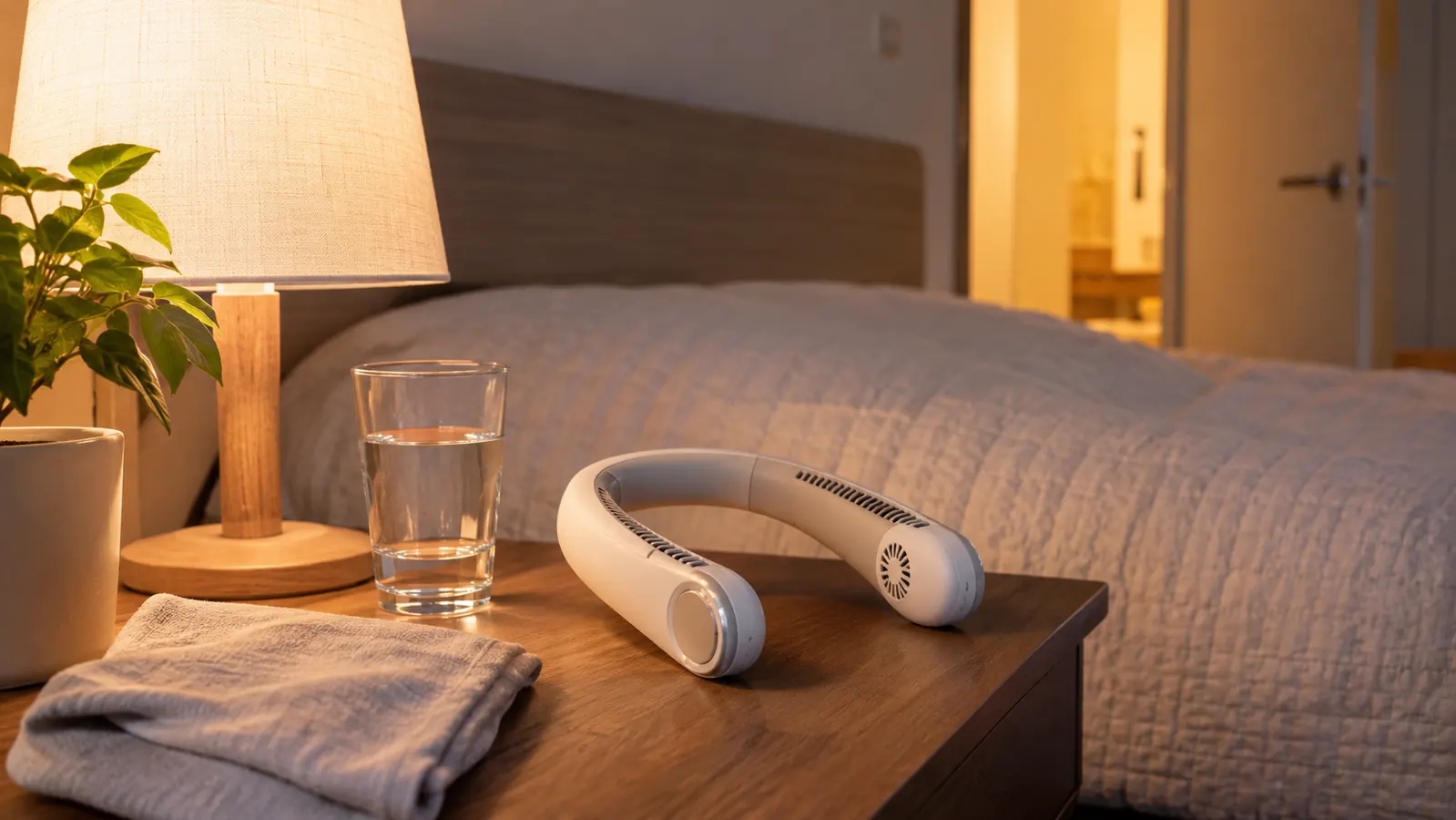
The fan has to be within arm's reach of the pillow. Mine sits on the nightstand on the side I sleep on, in front of the lamp and slightly to the left, and when I reach out in the dark my hand lands on it without any searching at all. That sounds like a small detail. At two in the morning it is the entire point. Anything you have to find, uncover or unwrap while you are overheated and half asleep is a thing you will stop using by the second week.
The top drawer of my nightstand is where good intentions go to die, so nothing I need in the night lives in there anymore. The fan stays out, on the surface, in the same spot, every single night, whether it is 95 degrees or 70. Consistency is what makes your hand find it in the dark without waking up the rest of your brain.
While you are at it, clear some space around it. The fan measures roughly 7.7 inches by 7.7 inches by 2.3 inches, which is larger than I pictured from the photographs, and it takes up real room on a small nightstand. Mine shares the surface with a lamp, a glass of water and the white noise machine. That is the full inventory. Everything else moved to the dresser.

Step 2: Pick Your Speed Before You Get Into Bed
This one runs on a button, not a dial, and it has five speeds. That matters at night, because a button means you press through the settings in order, one step at a time, and you cannot accidentally land halfway between two of them in the dark. What I do is set it before I get into bed. I press through to my night speed, put it back down, and leave it alone until I need it.
Middle speed is my night speed. Not the highest. I started on the highest setting in June, because it was June and because more felt like better, and what I learned is that the strongest setting is a jolt. It is great at three in the afternoon when I am doing dishes. At two in the morning what I want is a steady stream across the back of my neck, and the middle setting gives me that without making me feel like I have put my head in front of a hand dryer.
The listing puts the noise level at 25 dB. I do not own a decibel meter and I am not going to pretend I do. What I can tell you is that from a foot away it sounds like breathing, that I can hear the white noise machine over it, and that in five months it has never once been the thing that woke me up. That last part is the only measurement that counts for me.
Step 3: Sit Up When You Wake, Don't Lie There and Negotiate
Here is the mistake I made for two years. I would wake up hot and lie perfectly still, telling myself it would pass in a minute. It never passed in a minute. It passed in twenty-five minutes, after the damp had spread and the sheet had gone warm and I was annoyed on top of being hot. Lying still is a strategy that only works if you are not actually sweating. If you are actually sweating, you are just marinating.
So now I sit up. Feet on the floor if it is a bad one, sitting on the edge of the mattress if it is a mild one. Sitting up gets your back off the mattress, which is where the heat has been collecting all night, and it puts your neck into open air. That alone takes the edge off. Then I pick the fan up off the nightstand and settle it around my neck. One motion, no thought required, which is the standard I hold all nighttime equipment to.
The fan is bladeless, which I care about more than I expected to. It weighs about nine ounces, so it is not weightless, but it stays where you put it and it does not need a hand to hold it in place. That leaves both hands free for the water glass, which is the other thing I do while I am sitting there being sensible instead of lying down being miserable.
Step 4: Give It Ten or Fifteen Minutes, Then Take It Off
I do not sleep in the JISULIFE fan. I want to be clear about that, because it is the part people ask me about. I wear it for ten or fifteen minutes, sitting up, until the heat has come off my neck and my breathing has slowed back down. Then I take it off, put it back on the nightstand, and lie down. That is the whole routine, and this is the step that makes it work.
The reason is not that the fan is uncomfortable. It is that a fan around your neck is doing one job and sleeping is a different job. When I have tried to lie down wearing it, it shifts against the pillow and the airflow moves up toward my jaw, and I spend the whole time adjusting instead of drifting off. Ten minutes sitting upright beats forty minutes of fidgeting, every time, and I have tested that more nights than I would like to admit.
On a bad night I run the routine twice. Sit up, fan on for fifteen, off, lie back down. If the heat comes back an hour later, I do it again. Five months in, most nights it is once. In July it was two or three times. None of that is a cure and I am not going to dress it up as one. It is a way to get back to sleep faster than I used to, and that is the whole claim.
Step 5: Charge It on a Schedule That Fits Your Week
The battery is 4000 mAh and the run time runs from 4 hours at the top speed to 16 hours at the lowest. Since I use mine on middle for ten or fifteen minutes at a time, plus some reading before lights out, I charge it every few days. It has never gone dead on me in the night. I have never once had to get up and hunt for a second solution at two in the morning, which after two years of this is the thing I value most.
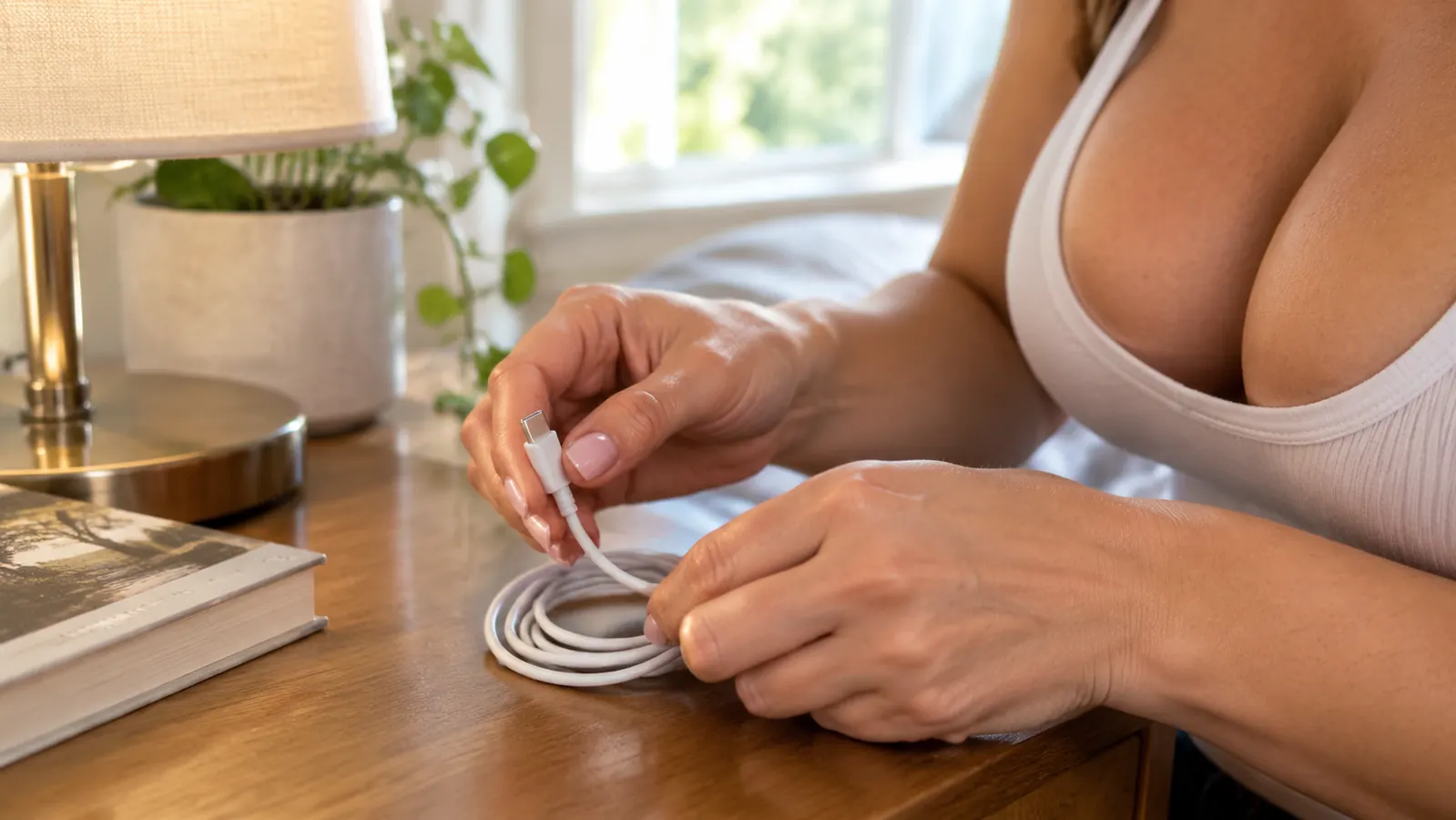
What makes that work is that charging happens in the morning, not at bedtime. The USB-C cable that comes in the box lives coiled on the nightstand, and the JISULIFE goes onto it while I am getting dressed. By the time I leave with my coffee, it is full. If I waited until I was tired, I would forget, and forgetting is exactly how you end up with a dead fan on the one night you actually needed it.
If you want a schedule that is harder to forget, pick two days. Mine are Sunday and Wednesday, mostly because Sunday is the day my daughter Kayla drives over and I am already doing laundry and thinking about the week ahead. Two charges a week covers the way I use it with room to spare, and it means the fan is never the thing I am thinking about when I should be asleep.
What Else Helps
The fan handles the neck. It does not handle the bed, and the bed is where you are lying. The biggest improvement in this room came in February, before the fan, when I replaced an old jersey-knit cotton set with a cooling sheet set that does not hold heat. They are not cold to the touch, whatever the packaging implies. They simply do not cling when I sweat, and that one change cut down how often I woke up stuck to the mattress.
Same story with the pillow. The one I had was a flat polyester fill number from a big-box store and I flipped it at three in the morning most nights. The cooling gel foam pillow I bought in March did not make anything cold, but it stopped holding heat the way the old one did and I stopped flipping it. Between the sheets and the pillow I went from about four wakeups a night to about two, which is the kind of progress nobody puts on a poster.
The white noise machine does a different job entirely and I would not give it up. It does not touch the heat. What it does is cover the neighbor's dog, the garbage truck at five and the click of the central air kicking on, all of which used to grab me right as I was drifting back off. The fan gets me cool. The noise gets me back under. I need both, and dropping either one puts me right back where I was two years ago.
Two things I did not buy. My ceiling fan was already in the room and it runs all night whether or not the neck fan comes out. And the thermostat sits at 72 because of the power bill, not because 72 is my ideal sleeping temperature. I mention both because a neck fan is not a replacement for moving the air in the room. It is what you reach for when the air is already moving and you are still too hot anyway.
The fan does not cool the room. It cools the back of my neck for fifteen minutes, and fifteen minutes turns out to be exactly what I needed.
What It Won't Do
It will not stop a hot flash. Nothing I have bought for this bedroom stops one, and I would be lying to you if I said otherwise. What it does is shorten the stretch where you are awake and uncomfortable, from something like half an hour down to ten or fifteen minutes. That is a comfort improvement. It is not a medical one, and I am not going to blur the two so a listing looks better.
And if the night sweats are new, or getting worse, or arriving with anything else that worries you, that is a conversation for your doctor rather than a shopping cart. I had that conversation. I am not going to tell you what came out of it, because that is between you and your own physician. What I can tell you is what helps me sleep through the heat in a one-story brick ranch in Chattanooga, and this is it.
Fifteen minutes on the middle setting, then back to sleep
Bladeless and hands-free, five speeds on a button, 4000 mAh, USB-C charging. Mine has been on the nightstand since June and it has never gone dead in the night.
Amazon See Current Price on Amazon →