
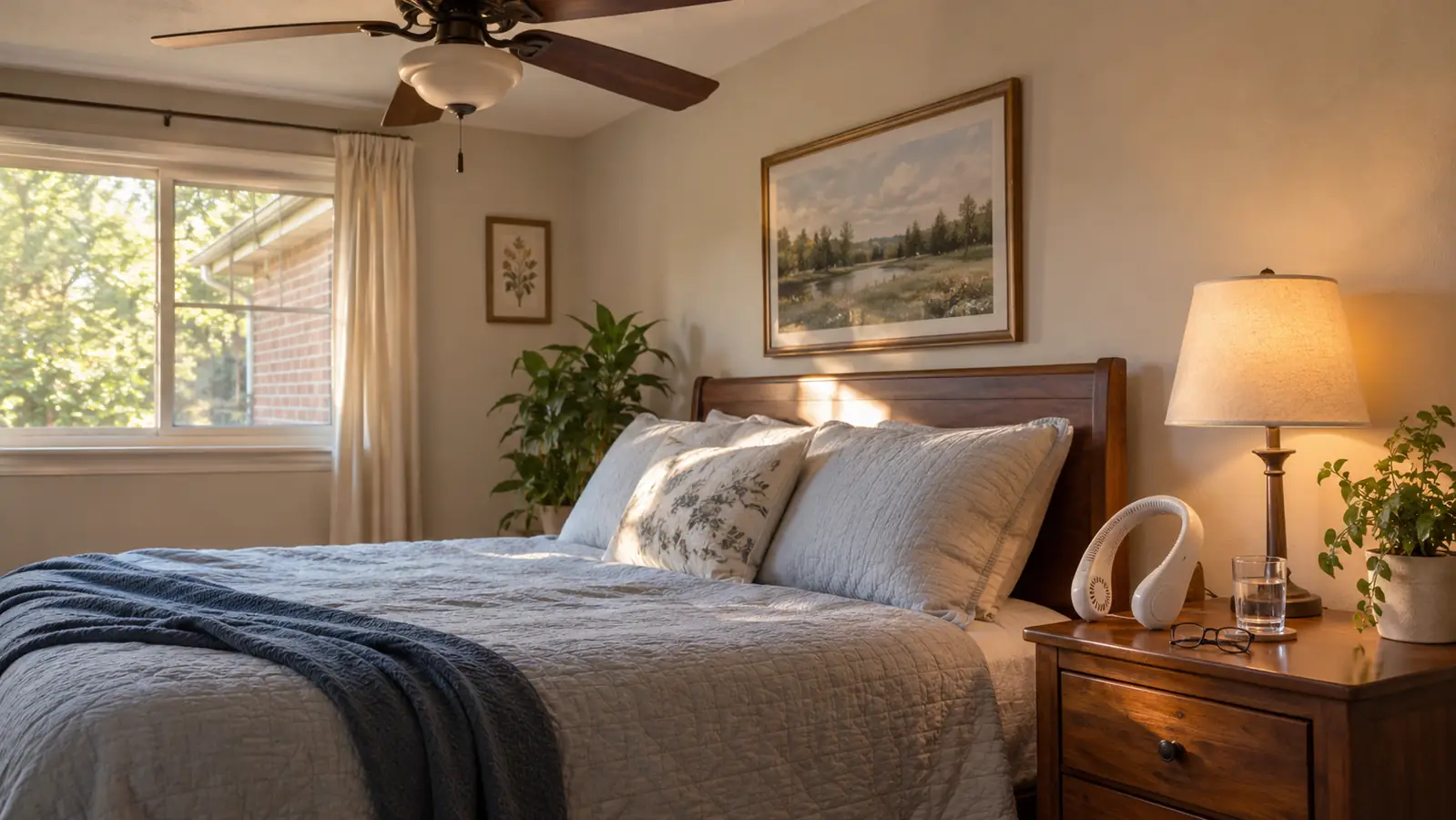
A hot flash at 2:40 in the morning gives you about four seconds to decide what you are going to do about it. For two years my answer was to lie perfectly still and hope it burned itself out, which it usually did, right around the time the clock rolled to 4:15 and any chance of going back to sleep went with it. In June I put a JISULIFE neck fan on my nightstand. It is now the first thing my hand finds in the dark, ahead of my glasses and ahead of the water glass.
Short answer: a small desk fan and the JISULIFE Neck Fan are not the same tool, and I would not swap one for the other. A desk fan pushes air at one fixed spot all night and asks nothing of you but a wall outlet. The neck fan goes where you go, weighs 8.96 ounces, and lets me sit up, cool my neck and face for ten or fifteen minutes, then take it off and lie back down. One is background. The other is a reply. My nights needed a reply, which is why there is no desk fan on the other side of my nightstand.
| JISULIFE Neck Fan | Small Desk Fan | |
|---|---|---|
| How it moves air | Worn around the neck, hands-free, 78 air outlets send air at your neck and face | Sits on a surface and blows at one fixed spot |
| Hands free | Yes. Nothing to hold, so you can read, fold laundry or stand at the sink | No. It cools the spot it points at, and you have to be in that spot |
| All night, unattended | 4 to 16 hours per charge depending on speed, then it needs a USB-C cable | Runs continuously off the wall outlet, no charging and no cutoff |
| Weight on your body | 8.96 ounces around your neck | Nothing on you at all, but it owns a patch of the nightstand |
| Portability | Battery powered, charges at 5 volts over USB-C, goes to the kitchen, the porch and the library | Tied to an outlet and a flat surface |
| Noise | Motor rated at a noise level of 25 dB | Varies by model and by speed, and the cheap ones rattle |
| Controls | Button control, 5 speeds | Usually one button or a dial, two or three speeds |
| Footprint | 7.7 inches by 7.7 inches by 2.3 inches, sits flat on the nightstand or goes on your neck | Takes nightstand space and has to be aimed at the bed |
| Best for | Waking at 3 a.m. soaked and needing to cool down fast, then get back to bed | Constant air on one spot from lights out to the alarm, with nothing to charge |
Where the JISULIFE Neck Fan Wins
The thing nobody tells you about a 3 a.m. flash is that you are not lying there for the air. You are lying there because getting up feels like admitting defeat. The neck fan solves that specific problem and almost nothing else. I do not have to get out of bed, I do not have to cross the room to find a switch, and I do not have to hold anything. I sit up, press the button until I land on a middle speed, and let it run for ten or fifteen minutes.
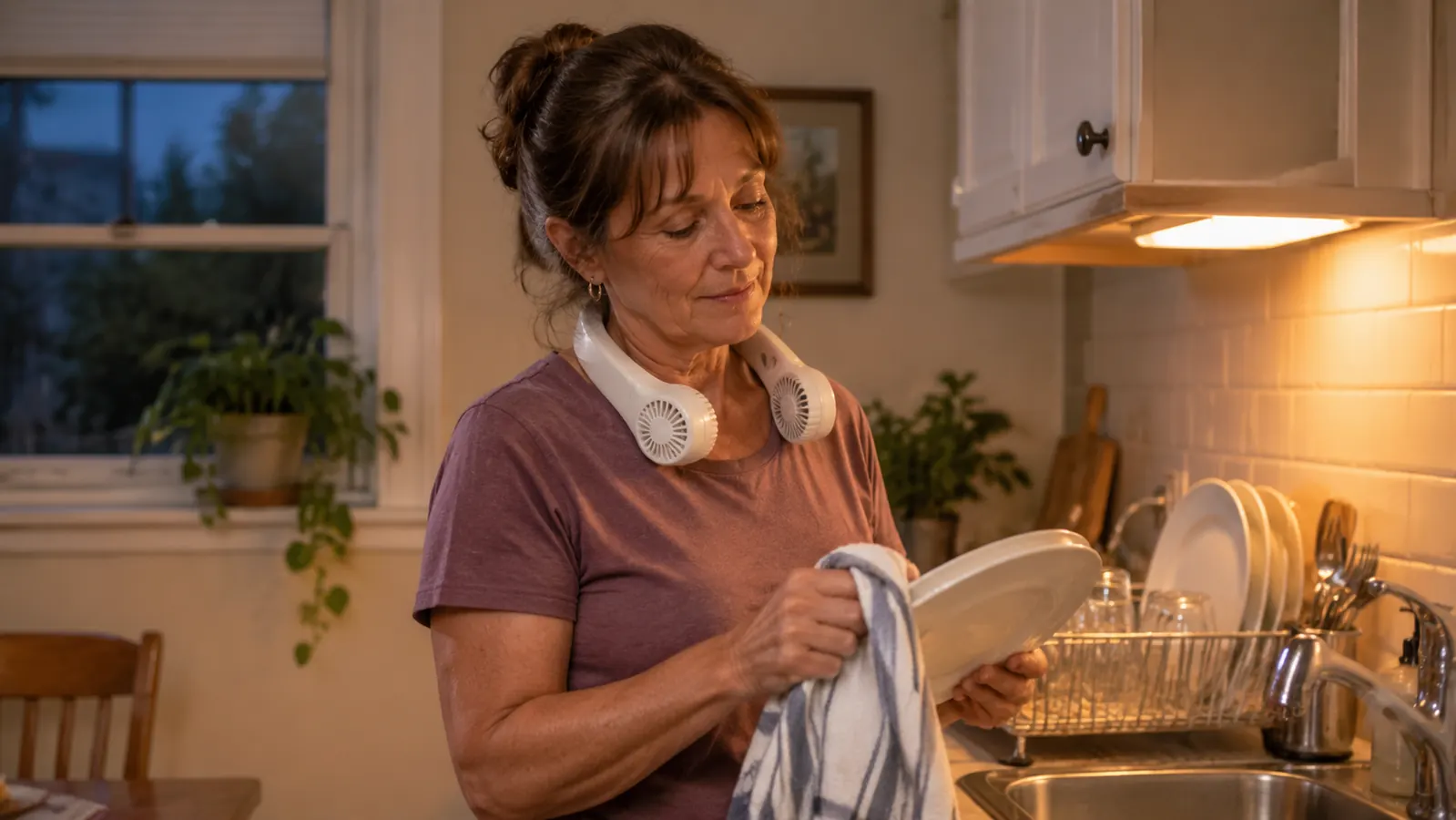
One night in early July I came home from the library at 5:30 with the house still holding the afternoon. I had a stack of returns to process, dishes in the sink, and a flash that started while I was standing at the counter. I put the fan on, turned it to the third speed, and folded a load of towels while it worked. By the time the towels were in the drawer the flash had passed and I had not sat down once. A fan across the room could not have done that, because I was not in the room it would have been aimed at.
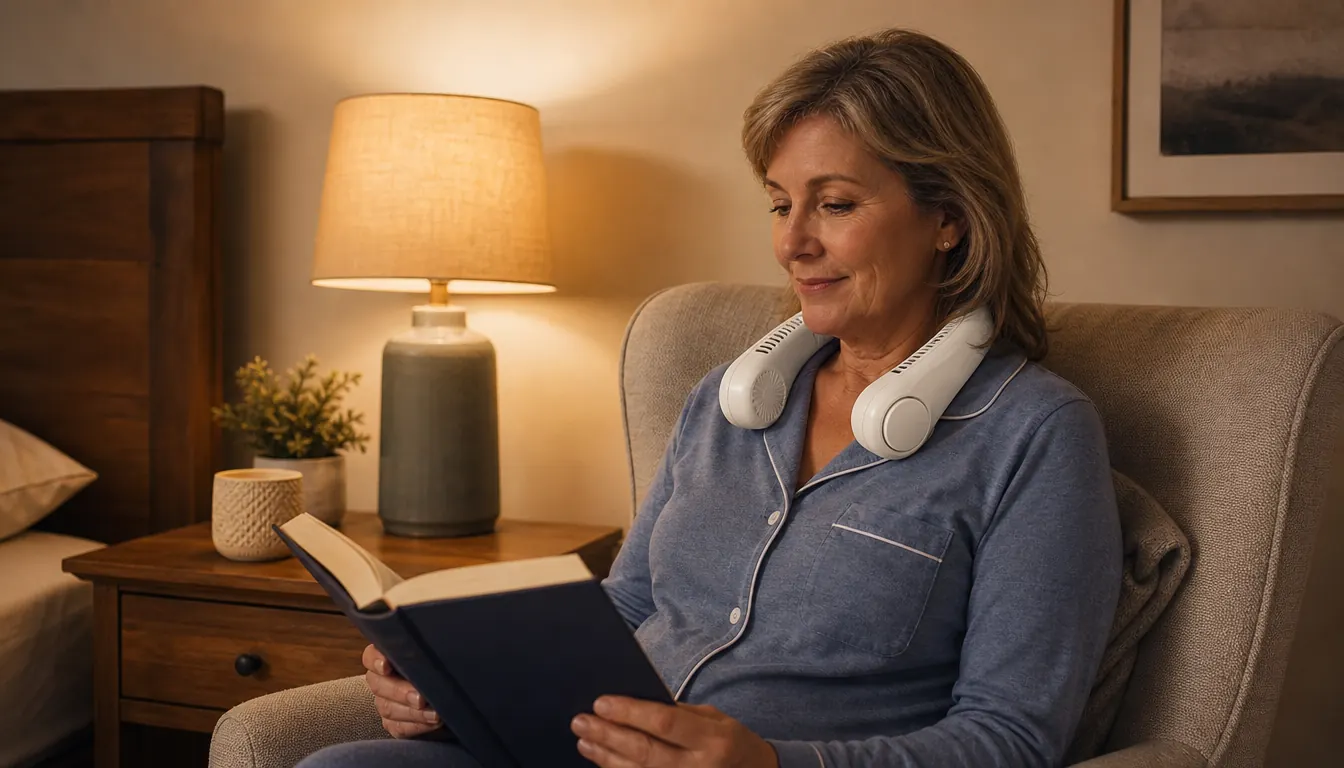
The second thing it does is follow me. In June and July I wore it while doing dishes, while folding laundry, and while reading in bed before lights out. A desk fan cannot do that. It cools the patch of air in front of it and you have to keep coming back to that patch. The neck fan is battery powered, with a 4000 mAh battery and a USB-C cable in the box, so the only thing tying it to a wall is a short charge every few days.
Where the Small Desk Fan Wins
I have never owned a desk fan beside the bed, and I am not going to pretend otherwise. My only other fan is the ceiling fan that came with the house. But Kayla has a box fan in her spare room, and I have spent enough Sunday afternoons there, plus enough nights in hotel rooms with a fan humming on the dresser, to know exactly what continuous airflow feels like.
Here is where that wins, and it is not a small win. It runs all night without a thought. No charging, no 4 to 16 hour range sitting in the back of your mind, no hunting for a cable on a Tuesday because you used it too long on Monday. If you are the kind of sleeper who wants moving air from lights out until the alarm, on the same spot, with nothing around your neck, the desk fan is the honest answer and I would not talk you out of it. That 4 hour end of the neck fan range is real if you run it high.
Cool the neck for ten minutes, then lie back down
This is the fan on my nightstand in Chattanooga. Button control, 5 speeds, bladeless, and 4 to 16 hours per charge depending on the speed you use.
Amazon Check Today's Price on Amazon →What 25 dB and 4 to 16 Hours Actually Mean at 3 A.M.
The listing puts the motor at a noise level of 25 dB, and the number matters less than the comparison. My central air kicks on with a click I can hear from the hallway, and the neck fan at a middle speed is quieter than that click. On low I have to put a hand in front of it to confirm it is running. That is the whole reason I can wear it for fifteen minutes and still be sleepy when I take it off. A loud fan wakes me up properly and then the night is over.
The 4000 mAh battery is rated at 4 to 16 hours depending on which of the 5 speeds you use, and my use looks nothing like that range. Ten or fifteen minutes at a time, three or four nights a week, plus a stretch of reading before lights out. I charge it every few days and it has never died in the middle of a flash. If you planned to wear it all night at the highest speed, you would be charging it daily, and that is worth knowing before you buy rather than after.
I timed it once, out of mild curiosity at 3 a.m. Ten minutes at a middle speed is nothing off a 4000 mAh battery. The range the listing gives, 4 to 16 hours, is really a map of the speeds: the low end is high speed, and the high end is low speed with the motor barely working. What I have learned in five months is that the middle speeds are the useful ones, and they sit comfortably inside the range. I have taken it out to the porch for a Sunday afternoon and back without charging it in between.
The 78 air outlets are why it does not feel like a hair dryer pointed at your chin. Air arrives at your neck and the sides of your face instead of one hard stream, and because it is bladeless there is no exposed fan to catch your hair when you lean back against the pillow. Hands-free is the part that keeps it on the nightstand. Both hands stay free for the book, the covers and the water glass.
I do not sleep in it. I sit up, run it on a middle speed for ten or fifteen minutes, take it off, and lie back down. That is the entire method.
What I Liked
- Hands-free, so it works while you read, fold laundry or stand at the sink
- Button control with 5 speeds, easy to find without turning on a lamp
- Motor rated at a noise level of 25 dB, quieter than the central air click
- 4 to 16 hours from a 4000 mAh battery, charging over USB-C
- 8.96 ounces, light enough to forget you have it on
- Works away from an outlet, which a desk fan cannot do
Where It Falls Short
- Needs a charge every few days the way I use it
- 4 hours is the low end of the range if you run it high
- Not everyone tolerates something around the neck, and that is fair
- It cools you and not the room, so the bedroom is exactly as warm as it was
What Neither One Does
Neither fan makes the bedroom cooler. This sounds obvious and yet I have caught myself expecting it. The central air sits at 72 because of the power bill, the brick holds the day's heat until well past dark, and the back bedroom faces east so the morning arrives early whether I am ready or not. A fan moves air across your skin. That is a comfort, not a temperature change, and it does not stop a flash from happening.
I worked out the room situation the hard way over one long August. The brick on the east side of the house soaks up sun all afternoon and gives it back until nine or ten at night, and my bedroom is the room on that side. Closing the blinds at four in the afternoon helps more than any fan, and I only mention it because I spent a whole summer buying fans before I tried the blinds. Neither fan in this comparison fixes a hot wall. They make the air around you move while the wall cools down on its own.
And plainly: none of this is a treatment for anything. Nothing on my nightstand reduces hot flashes, improves menopause symptoms or fixes sleep. These are comfort tools for the ten minutes when your body has decided the night is over. What your body is doing at 3 a.m. is a conversation for your doctor. Mine knows, and I do not discuss prescriptions or hormones here, because that is not my business to hand out.
How I Compared Them, Such as It Is
I buy one thing at a time and live with it for a few weeks before I buy the next thing. That habit is how the neck fan ended up here in June, and it is also why there is no desk fan on the other side of the nightstand. I am not going to invent a six-week trial I did not run just to make a table look balanced.
The desk fan question did come up in a hotel room in August, on a two-night trip where the room had a small fan bolted to the dresser, one speed, that ran from the moment I dropped my bag until I left. Two nights of that was genuinely pleasant, and I came home thinking about it. Then I looked at my nightstand, which already holds the white noise machine, a lamp, my glasses and a water glass, and did the arithmetic on the space. There is not much of it left.
What I can compare is the job. The only question I ask of anything in that room is whether it helps me get back to sleep at 3 a.m. without turning the night into a project. A desk fan is a project in one way and not in another. You aim it once and forget it, which is lovely, but it only helps if you happen to be in the line of it, and it does nothing for the ten minutes when you are sitting on the edge of the bed with your hair stuck to your neck.
The neck fan is the opposite trade. It asks a little more of you, meaning a charge every few days and something resting around your neck, and it gives you air wherever you happen to be. In November, with the central air at 72 and the ceiling fan turning on low, I still use it most nights. Not for the whole night. For the short stretch when the flash arrives and I want it gone.
Who Should Buy Which
Buy the JISULIFE Neck Fan if your nights look like mine did at 51 and 52. You wake two or three times, your sleep shirt is damp, and what you actually want is targeted air on your neck and face for a short stretch before you lie back down. It also suits anyone who reads in bed on summer nights, or stands at a hot sink in the evening, or wants the same fan in the kitchen and out on the porch. It is the one I own and the one I reach for.
Buy the small desk fan if you want stationary air for eight hours with no charging routine, and if wearing anything around your neck sounds like a nuisance rather than a help. Plenty of women cannot stand it, and that is not a small thing to wave away. If you already run a ceiling fan and the missing piece is constant airflow across the bed rather than a burst of air wherever you are, a desk fan on the dresser does that job and does it unattended.
If you can only do one, do the one that matches the shape of your bad nights. Mine were short, frequent and physical, which is why a wearable fan won. If yours are one long warm stretch from midnight to five, the fan that never stops is the better purchase. Two different problems, two different fans, and no reason to feel loyal to either.
The fan that earned its spot on the nightstand
Bladeless, hands-free, 5 speeds, and a battery that covers a week of short bursts. This is the one I bought in June and was still using in November.
Amazon Check Today's Price on Amazon →