
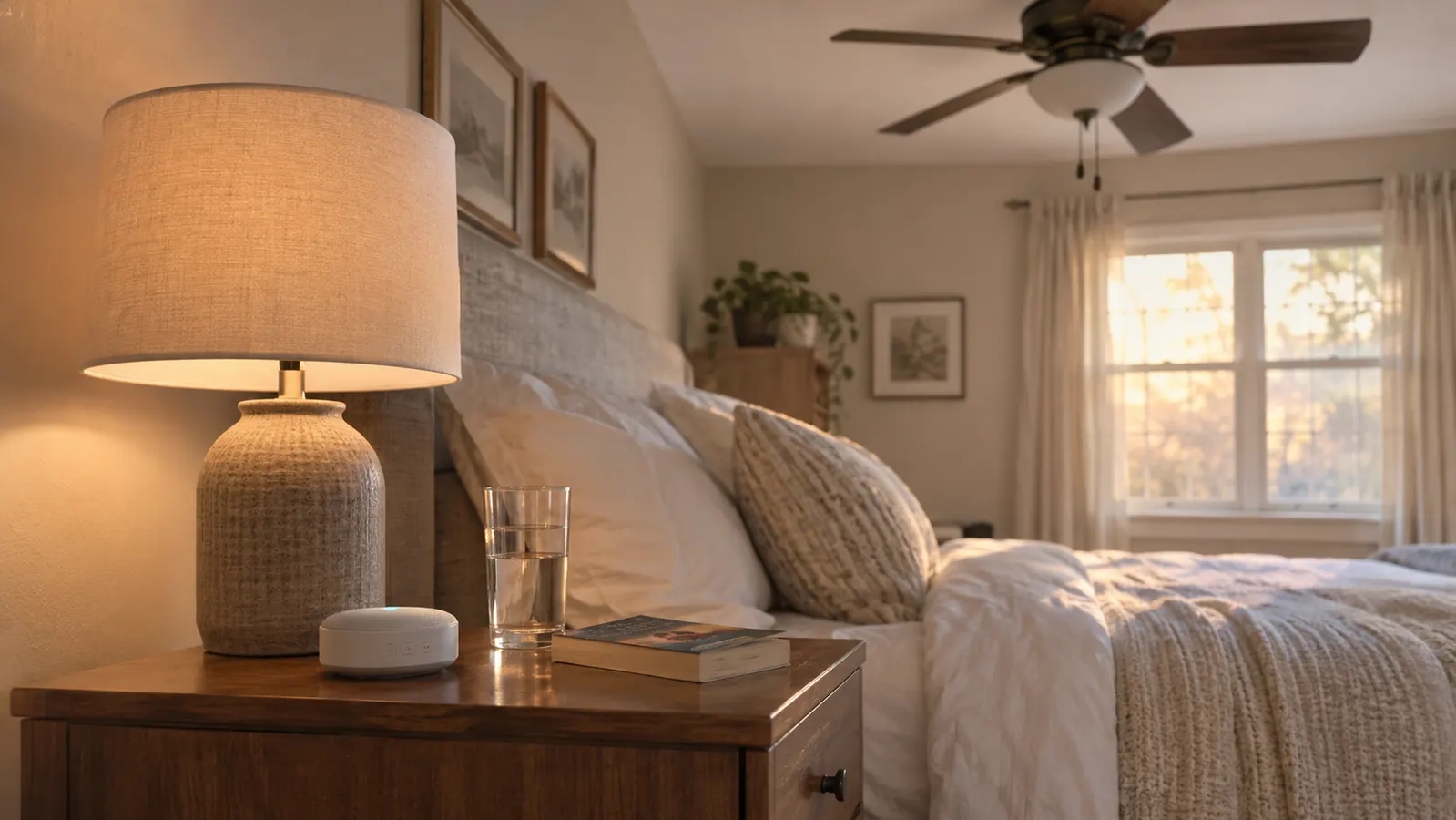
I bought the Magicteam sound machine in April, and for the first two nights I used it wrong. Not broken wrong. Set up wrong. It sat on the nightstand about a foot from my pillow, volume somewhere in the upper half of the range, ocean sound, timer set for one hour. The first hour was lovely. The second hour was silence, and then the neighbor's dog, and then the garbage truck at 5:15, and then me lying there at 5:20 doing arithmetic about how much sleep was left.
The machine was not the problem. My setup was. What follows is the version I settled on after a few weeks of moving it around, muting it, and arguing with it, and it is still what runs in my bedroom in November: brown noise, low-middle volume, timer off, all night long. Five decisions, in this order.
Here is what you are working with, if you have the same unit. The Magicteam has 20 sounds and they do not loop. That matters more than it sounds like it should, because a looping recording has a seam, and once your brain finds the seam it will find it again every night at the same interval. There are 32 volume levels, which is more range than you will ever use. There is a timer. There is a memory function, so the machine comes back on the way you left it. And it runs on wall power, which is the detail people miss in the listing photos and then complain about in the reviews.
Brown noise, low-middle volume, timer off
The Magicteam runs on wall power, which is why it can go all night without a battery question at 2 a.m. Twenty non-looping sounds, 32 volume levels, and a memory function that holds the setting you land on.
Amazon Check Today's Price on Amazon →Step 1: Choose the sound before you touch the volume
Most people pick the label that reads nicest on the box and then spend a week wondering why it does not settle them. Rain is pleasant and it also has a rhythm. Ocean has swells. If your brain is the kind that waits for the next wave, a sound with a pattern gives it something to wait for, and waiting is the opposite of what you want at eleven at night. The test is not which sound you like. It is which sound you can stop noticing.
I landed on brown noise, which is deeper and less hissy than white noise, with no pattern underneath it to follow. White noise is the bright one, the version most people picture when they hear the phrase. Fan is the one that sounds like a fan, obviously. All 20 live in the same small box, so this is a choosing problem and not a shopping problem, and you can take your time with it.
The way to test is one sound per night, not five minutes per sound on the couch with your shoes still on. Five minutes tells you whether you like something. A full night tells you whether it disappears. The right one is the one you stop hearing, and when you find it you will know, because you will stop thinking about the machine at all. I stopped hearing brown noise somewhere in the second week, and I have not changed it since. Nine months of the same setting, which for me is a personal record.

Step 2: Set the volume by the room, not by the number
Thirty-two levels is a trap, in the sense that it invites you to believe there is a correct one. There is not. There is a correct one for your room, and it will be lower than you expect. Mine is a back bedroom in a one-story brick ranch with the central air set to 72 and a ceiling fan running overhead, and the setting that works is roughly a third of the way up the range, which is where it has sat since April.
Here is the test I use. Stand in the doorway with the machine running the way it will run at bedtime. If you can hear the machine as a distinct sound, it is too loud. If you can hear the neighbor's dog, it is too quiet. Somewhere between those two is the setting where the room simply sounds like a room, and that is the one you want. My daughter Kayla sleeps with a box fan and hers is far louder than mine, which tells you there is no universal number and no prize for guessing it.
Then leave it alone for a week. Ears adjust, and the setting that felt slightly too quiet on night one will feel correct by night five. People reset the volume every single night and never get there. I know this because I reset the volume every night for nine days and told myself I was fine-tuning. I was not fine-tuning. I was restarting the clock.
Step 3: Decide whether you want the timer at all
The timer on this machine steps up in hours, not minutes, which tells you what it was built for: falling asleep with sound and not running it until morning. For plenty of people that is exactly right, and it is the reason the timer is there at all. For me it defeated the entire purpose, and it took about a week to work that out.
I wake up at 2 or 3 most nights. When that happens I do not want to lie in a silent room waiting for the dog, the truck, or the click the air handler makes when it kicks on. I want the room to already be running, so that I can be back asleep before I am awake enough to start thinking about anything. A timer cannot do that for you. Mine is set to off and runs until I switch it off in the morning.
If you are the sort who needs silence to fall asleep and only wants sound as a bridge, use the timer. If your issue is the two o'clock wake-up, run it all night. Those are the only two answers, and you will know which one you are by the end of the first week. There is no prize for picking the more disciplined option.
The brown noise covers the garbage truck at 5:15 and the click the central air makes when it kicks on. It does nothing for the heat. What it does is make sure the room is already running when I sit up at 2:40.

Step 4: Place it so it works on the room, not on your ear
Mine started a foot from my pillow, which was the first mistake. That close, you hear the machine instead of the room, and the machine is a small box on a nightstand. Move it out to about three feet, to the far edge of the nightstand, aimed into the open room rather than at your head. Nothing about the settings changes. Everything about how it sounds changes.
Surface matters too. A bare nightstand with a lamp, a water glass and a paperback is a hard surface with three things on it that can rattle. Set the machine down flat on its own, keep the cord clear of where your feet swing when you get up, and do not stack it on a book to move it closer to your ear. It weighs under six ounces, so a cord pulled tight at three in the morning will take it off the table without any argument.
Be honest about what placement can fix. My bedroom faces east and gets the early sun, and no sound machine has ever dimmed a sunrise. The machine covers noise. Light, heat, and a full bladder are three separate problems with three separate solutions, and expecting one small box on a nightstand to handle all four is how people end up writing one-star reviews about a product that was doing its job the whole time.
Step 5: Set it once, let the memory function hold it, and leave it plugged in
The Magicteam needs to be plugged in. That is in the listing in plain language and it is still the thing people are surprised by, so check your outlets before you fall in love with a spot on the dresser. It comes with a USB connector and it wants wall power for the night. If the nearest outlet is behind the bed, you are going to want an extension cord before bedtime, not after.
Once the sound, the volume and the timer are where you want them, the memory function keeps them. That sounds like a minor line on the box and it is the reason I stopped fiddling. I set mine in April. Since then the only time I touch it is to mute it on a Sunday afternoon when Kayla is over and we are talking in the kitchen instead of sitting in the bedroom.
The size helps here. It measures about 2.6 inches on each side and under three inches tall, so it does not compete for space with the lamp, the glass, and whatever book is currently losing to my phone. I knocked it onto the rug exactly once, in June, picked it up, put it back, and went to sleep. That is the entire maintenance story.
What Else Helps
A sound machine covers noise. That is the whole job, and it does it well. My nights got better in layers, and the machine was the third layer, not the first. The sheets came in February, the pillow in March, the machine in April, the neck fan in June, and the weighted blanket in August, one at a time with a few weeks in between so I could tell whether each one actually did anything.
The rest of the room is doing quiet work too. The ceiling fan I already owned moves air and adds its own low sound. The central air stays at 72 because of the power bill, and it clicks when it starts. Between the fan and the machine there is a floor of noise in that room that does not stop, and that floor is why I sleep through more nights than I used to.
If you already own a box fan, start there. Kayla sleeps with one and swears by it, and a fan you already have costs nothing and covers more than you would think. The reason I ended up with the machine instead is control: 20 sounds and 32 volume levels means I can put the noise exactly where I want it, and a box fan has one speed that you argue with all summer.
What none of it does is cool you down, and none of it touches the flashes themselves. If you wake up drenched at two in the morning, the machine helps you fall back asleep afterward. It does not stop the waking. That is a conversation for your doctor, and it is a better use of an afternoon than buying a sixth object for the nightstand and hoping.
If you wake at 2:40 and the room is too quiet, start here
Twenty non-looping sounds, 32 volume levels, wall power so it runs until morning, and settings that stay where you put them. It will not cool you down. It will give you something to fall back asleep to.
Amazon Check Today's Price on Amazon →