
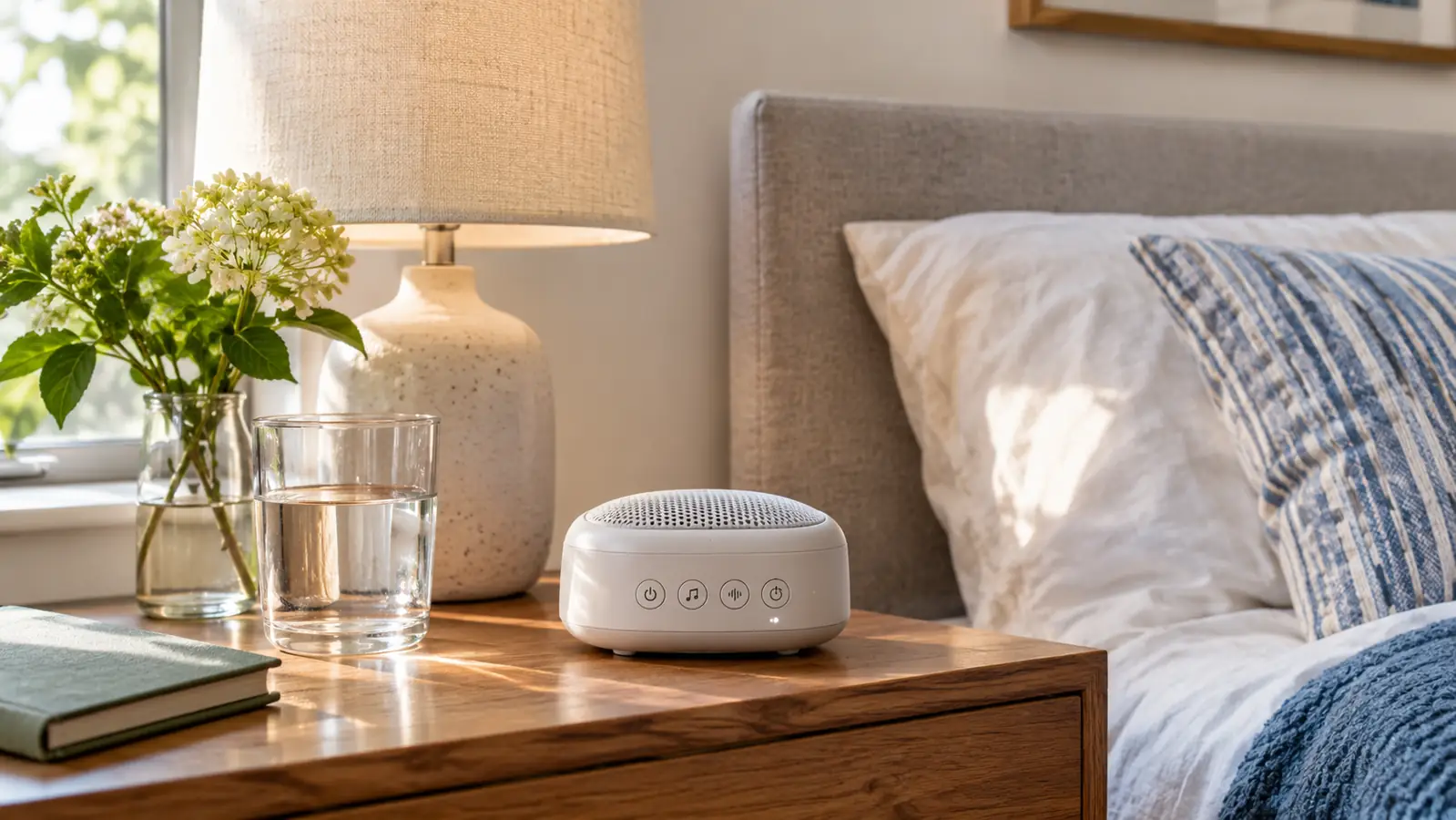
The garbage truck comes down my street at 5:40 every morning. The neighbor's dog starts up at 6:10. And somewhere in between, the central air in my house clicks on with a small hard sound that should not wake a person and does anyway. By April I had already bought the sheets and the pillow, and neither of them had anything to say about noise. The Magicteam white noise machine was the third thing I tried, and it is the only one of the three that works on something other than temperature.
I am 53, I run the library at a middle school here in Chattanooga, and I have been waking up in the small hours since I was 49. The worst stretch was 51 to 52, when I woke three or four times a night and kept a spare sleep shirt on the nightstand because I knew I would need it. I sleep through more nights than not now, but most nights I still get a flash somewhere around 2 or 3, and once I am awake the house is loud enough to keep me that way. That is the exact job I bought this machine to do. I want to be straight with you about what it fixes, because it is not everything, and a review that pretends otherwise is not worth your time.
The Quick Verdict
20 non-looping sounds, 32 volume steps, and a bottom end quiet enough to actually leave running. It masks the house. It does nothing for heat, and it must stay plugged in.
Amazon Check Today's Price →The quiet end of 32 volume steps is the part that matters
Twenty non-looping sounds, a memory function that holds your setting overnight, and a timer you can leave off so it runs until morning.
Amazon Check Today's Price on Amazon →How I've Used It
The machine arrived in April and went straight onto the nightstand on the left side of my full bed, plugged into the wall. It has not moved since. I run it on brown noise, at a low-middle volume, with the timer off, so it runs from the time I get in bed until I switch it off in the morning. That works out to roughly seven hours a night, seven nights a week, and in that time it has not given me a single moment of trouble. No cutouts, no odd noises of its own, nothing to reset.
The nightstand is a small one, and it already carries a lamp, a clock and a glass of water, so placement took ten minutes of rearranging on a Saturday afternoon before I was satisfied. The machine ended up at the back left corner, out of elbow range, with the cord run behind the nightstand to the outlet rather than across the top where I would knock it. The flat top collects dust the way any flat surface does, and I wipe it with a dry cloth when I change the sheets on Saturdays. There is no screen to smudge and there are no openings that catch lint.
The first week I went through the other sounds in the evenings while I read, because I wanted to know what I had bought before I committed to one setting. The rain and the brook are pleasant and far too recognizable. My brain follows them, the way it follows a conversation in the next room. The ocean has a rise and fall that I found myself waiting for, which is the opposite of what I want. The fan sound is fine and is probably what most people will settle on. Brown noise is the one that turns into nothing. After about ten minutes I stop hearing it, and that is the entire point.
What it covers, specifically: the garbage truck, the neighbor's dog, the click of the central air kicking on, and the low grind of a car idling at the stop sign at the end of the street. What it does not cover: a lawnmower directly outside the window, or my own internal thermostat. This is a sound machine. It is not a fan, it does not move air, and it has never once made me cooler. I keep a neck fan on the same nightstand for the nights when heat is the problem, and they do different jobs.
The 20 Sounds, and Why Non-Looping Is the Whole Point
A cheap sound machine plays a thirty second clip on repeat, and somewhere around the third pass your ear finds the seam. Mine does. Once I hear it I cannot unhear it, and the machine has made my problem worse instead of better. Magicteam sells this one as 20 non-looping sounds, and after seven months of nightly use I have not caught a seam in the brown noise setting. That single detail is worth more to me than every other feature on the box.
I spent a Sunday afternoon in May trying to catch it out. I left brown noise running while I stripped the bed, carried the sheets to the washer and came back to remake the mattress, which is twenty-five minutes in the same room with nothing else to listen to, and I could not find a repeat. Later that week I did the same with the rain setting while I folded laundry on the bed. If there is a seam in either one, it is longer than the stretch of time I was willing to stand there listening for it, and that is good enough for a bedroom at 3 a.m.
The sound list covers white, brown, pink and blue noise, then a fan, a brook, rain, ocean, birds and a bonfire, with variations across the 20 settings. The bonfire surprised me. It is a crackle with a low rumble under it, and it is the second best thing in there if noise colors are not for you. My daughter Kayla, who is 28 and lives across town, uses a box fan for the same reason I use this, and she says the fan setting on mine sounds close enough to hers that she would not bother with a real fan. I have never run a box fan in my bedroom, so I take her word for it.
Twenty options is more than anyone needs, and I would rather have four good sounds than twenty average ones. But the twenty are not really a drawback. They mean the first week involves some auditioning, and then you pick one and never touch the rest again. I have not changed my setting since the second week of April.
After about ten minutes I stop hearing it. That is the whole point, and it is the thing a cheap machine cannot do.
The 32 Volume Levels, and Why the Low End Is the Whole Game
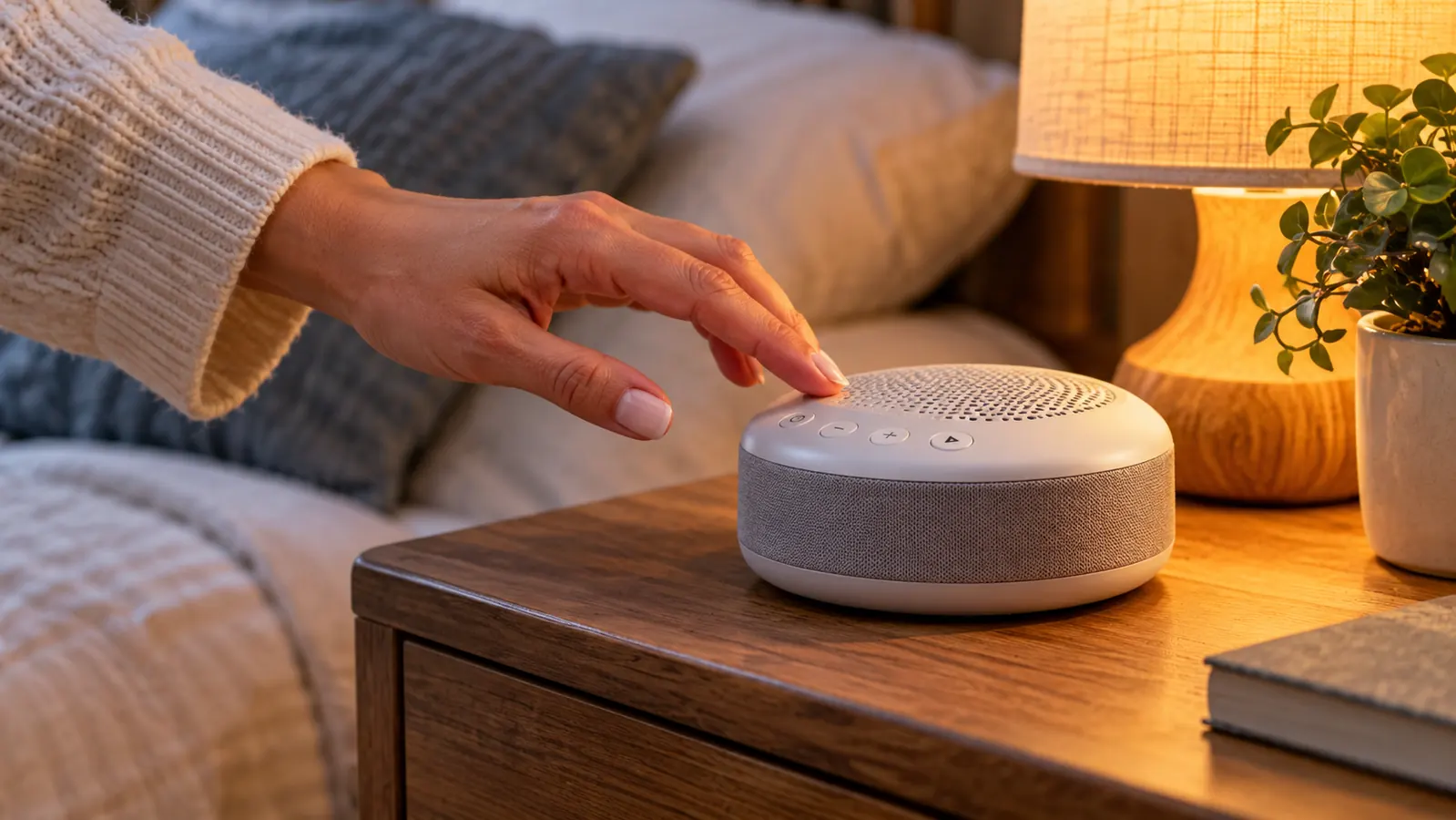
Thirty two volume steps is more than a bedroom requires. What matters is how quiet the bottom of the range goes, because a masking sound that is too loud is just a new noise to be irritated by at 3 a.m. The bottom few steps on this machine are quiet enough that I can hear the clock in the hall over them. I run somewhere in the low middle, loud enough to flatten the air handler and quiet enough that I forget it is on, and I have not needed to move it in seven months.
There is one thing I would change. Getting from a high setting back down to a low one means holding the volume button and waiting, and I have not found a shortcut that jumps straight to the bottom. In August the air handler was cycling hard through a hot stretch and I nudged it up two steps for a week, then spent an evening stepping it back down to where it started. It is a small irritation and it is the only one I have, but if you fiddle with volume the way I do, know that it is a hold-and-wait, not a press.
If you share a wall with a neighbor, or sleep next to someone who goes to bed earlier than you do, the low end is the reason this works. A box fan has one volume and it is whatever the fan decides to be. This has 32, and the useful ones out of those 32 are the quiet ones.
The top of the range is genuinely loud. I moved it up once to hear what it could do and then brought it straight back down. It would cover a house with children in it. It is not what I would use in a bedroom, but it is there.
The Timer, the Memory Function, and the Cord
The timer offers one hour, two hours, three hours, and off. I use off. My reasoning is that the noises I am masking do not stop at 2 a.m., and a machine that quits in the middle of the night is worse than no machine at all, because the change itself is what wakes me. If you fall asleep to sound and no longer need it after an hour, the timer is there for you. That is a preference, not a defect, and I would not want anyone to read my setting as the correct one.
The memory function means it comes back on at whatever you had it on the night before. That sounds like a small thing until you have owned a machine that resets to a default chime every single evening at bedtime. Mine returns to brown noise at the same volume, every time, without being asked.
It has to be plugged in. The listing says so plainly and it is true in my house. It runs off wall power through a USB connector, there is no battery, and it will not travel to a hotel room that has no free outlet near the bed. It weighs 5.76 ounces and measures 2.64 by 2.64 by 2.83 inches, so size is not the obstacle. The cord is the obstacle. If portability is what you are shopping for, this is not that product.

What It Does Not Do
It does not cool anything. It does not move air. On a night when a flash wakes me at 2 a.m., the machine has already been running for four hours, it is not what woke me, and it is not what cools me down. What it does is make the room boring again, so that once I have dealt with the heat I can get back to sleep instead of lying there listening to the air handler and the dog and the truck.
It is also worth saying that a machine running all night is a machine you notice when it stops. The one time the Magicteam machine went quiet was a brief power cut in July, and I woke within a minute of the room going flat, which tells you how much of my sleep is built on it by now. The power came back and the memory function put it straight back to brown noise at the same level without any help from me. That is the whole case for the memory function in one small story.
I want to be careful here, because there is a lot of nonsense written about sleep products and I am not going to add to it. This is a sound machine. It does not treat hot flashes, it does not lower your body temperature, and it is not a medical device. If your sleep has been broken for months, that is a conversation for your doctor. What I can tell you is that a quieter room made it easier for me to fall back asleep after a waking, and that is a comfort problem, not a medical one.
What I Liked
- 20 non-looping sounds, so the ear never catches the seam of a repeating sample
- 32 volume steps, and the bottom few are genuinely quiet enough to sleep beside
- Memory function returns to your setting every night without a reset
- Small on a nightstand at 2.64 by 2.64 by 2.83 inches and 5.76 ounces
- Brown noise at a low-middle setting covered a garbage truck, a dog and the air handler
Where It Falls Short
- Must be plugged in, with no battery, so it stays home
- Does nothing for temperature, night sweats or a warm bedroom
- 32 steps means getting from a high setting down to a low one is slow
- The top of the volume range is far louder than any bedroom needs
Who This Is For
This is for a woman who has the temperature side mostly handled and has worked out that the remaining problem is that the house is loud at 3 a.m. If you wake up and the waking is what keeps you up, this helps. If you wake up drenched, this does nothing for that at all, and I would put the money toward a cooler pillow or a fan first. I bought the sheets in February and the pillow in March before I bought this in April, and I would buy them in that order again. Noise was the third problem, not the first.
It is also for anyone whose bedroom backs onto a truck route, a dog, a highway or an air handler that announces itself. That is not a menopause problem. That is a house problem, and the Magicteam machine handles it for about the same effort as plugging in a lamp.
Who Should Skip It
Skip it if you need something that runs on batteries or goes in a suitcase. Skip it if what you want is moving air, because it does not move air and a fan will serve you better. Skip it if you cannot tolerate any sound at all while falling asleep. That is more people than you would think, and no review is going to talk you out of it.
And skip it if the real wish is for the bedroom to be colder. This machine cannot make a warm room cool, and buying it hoping otherwise is how people end up writing one-star reviews of a product that did exactly what it said. It masks noise. On that one job, seven months in, I have no complaints.
If the house is what wakes you at 3 a.m., start here
20 non-looping sounds, 32 volume steps, and a setting that holds overnight. Plug it in, pick a sound, and leave the timer off.
Amazon Check Today's Price on Amazon →