

If you sleep hot, a weighted blanket sounds like a prank. You already wake at two in the morning with the covers kicked to the floor and a sleep shirt you have to change before you can lie back down. Adding ten or fifteen pounds of anything to that bed sounds like the opposite of help.
I thought so too. Then I bought one anyway, in late August, mostly because I had run out of other things to try and I am the sort of person who reads the return policy before she reads the product description. Ten weeks later it is still on my bed and I sleep under it most nights. But I bought it the right way, and that is the part worth copying. The blanket is the Topcee weighted blanket for adults, 15 pounds, the 60 by 80 inch Queen size. I am 53, I weigh about 150 pounds, and I live alone in a one-story brick ranch house in Chattanooga, which means nobody else has an opinion about what goes on my bed.
My hot flashes started at 49 and were at their worst around 51 and 52, when I woke three or four times a night and kept a spare sleep shirt on the nightstand. They have eased. I still have them most nights. Nothing I buy fixes that, and the Topcee does not claim to. What a blanket can do is make the hours between flashes easier to sleep through, and it does that badly or well depending on five decisions. Here is how I made them, in the order I made them.
If you weigh between 130 and 160 pounds, the 15 lb is the size built for you
That is the range Topcee prints on the 15 pound listing, and at 150 pounds it put me at almost exactly ten percent of my body weight. Settle the weight before you look at anything else on the page.
Amazon Check Today's Price on Amazon →Step 1: Pick the weight from your body, not from the photo
Weighted blanket listings generally tell you to choose 8 to 12 percent of your body weight, and Topcee says the same thing, with the 15 pound version aimed at sleepers between 130 and 160 pounds. At 150 pounds I land almost exactly at 10 percent, right in the middle of the range. That is not a coincidence, it is arithmetic, and arithmetic is the only part of this purchase that is not a matter of taste.
The common mistake is buying up. Twenty pounds sounds more serious, more therapeutic, more like something that would actually work. What it is, on a 150 pound body, is a blanket you fight. You turn over and it does not come with you. You end up awake for a different reason than heat, which is a foolish way to spend a night. The other mistake is buying down, to 12 or 10 pounds, because you are nervous about the weight. At that point you have bought an expensive quilt with a marketing department.
My rule after ten weeks: if you are between sizes, take the lighter one. If you are near the top of a range on the listing, still take the lighter one. The weight is supposed to feel like being tucked in, not like being held down. The first three nights I noticed it every time I moved. By the fifth night I had stopped noticing it at all, which was the goal.
Step 2: Size it to the sleeper, not to the mattress
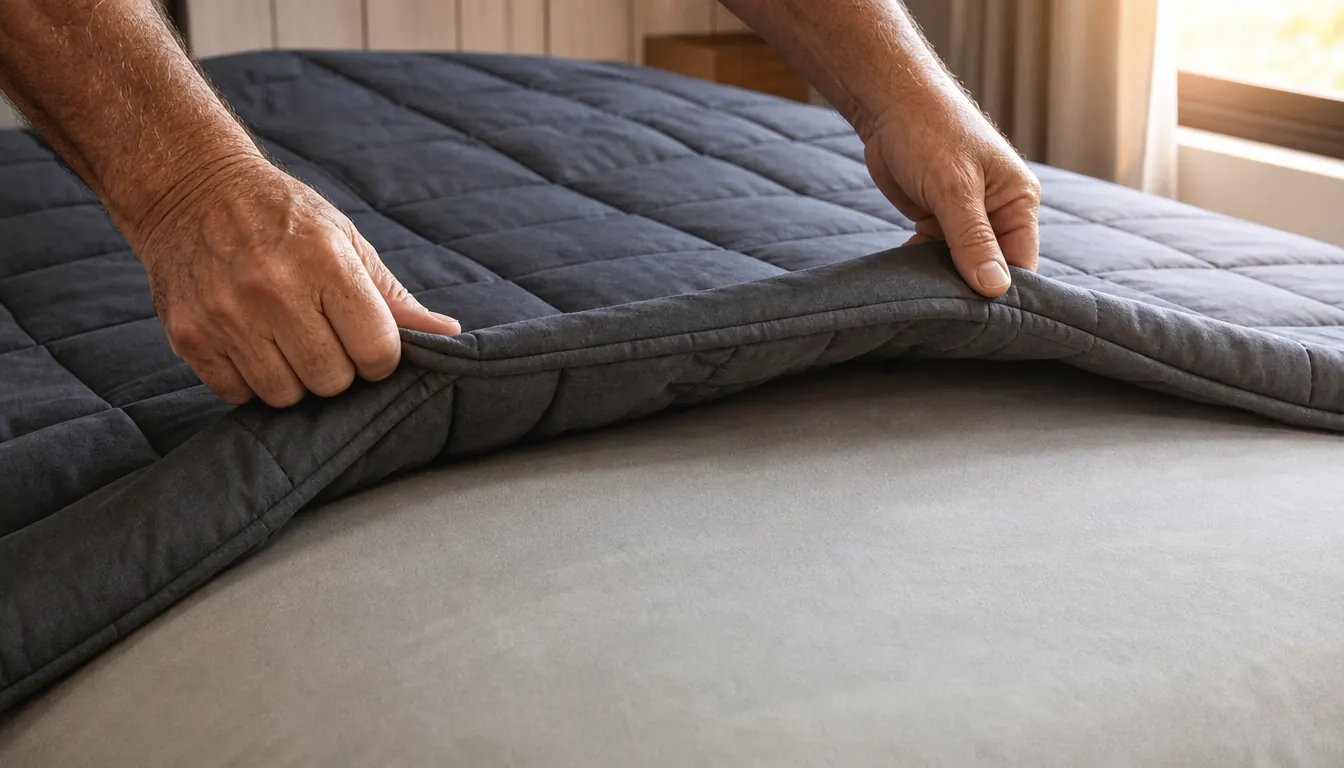
The 60 by 80 inch size is sold as Queen. My bed is a full, and the blanket is narrower than the mattress plus its overhang on each side. That looks wrong on the first night and is not wrong at all. Weighted blankets are built to cover the person, not the bed. The fill is sewn into chambers sized for a sleeper, and the weight is meant to sit on you rather than hang off an edge doing nothing.
Mine lies on top of the flat sheet and covers me from the shoulders down with a little to spare at the feet. If you buy oversized so it drapes toward the floor, you have added weight that pulls at the sides, more surface area for the fill to shift in, and a blanket that is harder to straighten in the morning. Nobody has ever come into my bedroom and complained that the blanket did not reach the baseboard.
Measure the mattress, then measure yourself. If you are short, extra length is dead weight past your toes. If you sleep curled up, you need less length than the chart suggests. My full bed and my 60 by 80 blanket have been a better pairing than the Queen label implied.
Step 3: Read the fill and the shell before you read the word cooling
The word cooling does a great deal of work on these listings, mine included. Here is what the Topcee actually is, according to its own specifications: a 100 percent polyester microfiber shell, filled with glass beads between 0.8 and 1 millimeter, quilted in a geometric pattern. The listing describes a bead positioning technique meant to keep the fill from sliding to one end. Microfiber is smooth. It is not cold to the touch and it will not refrigerate you, and any listing that implies otherwise is selling you a feeling.
What it does do is fail to trap heat the way my old heavy polyester comforter did. That comforter is folded in the hall closet now. Under it I would wake damp across the chest. Under the weighted blanket I wake up warm, which is a different thing entirely, and most nights I do not wake until the alarm.
Glass beads rather than plastic pellets matter more than shoppers expect. Glass is denser, so the blanket stays thinner for the same weight, and thin is exactly what you want in a hot bedroom. A thick blanket with the same number on the label will sleep warmer. Chamber size matters too. Small quilted chambers keep the fill where it was sewn when you roll over at three in the morning. Large ones leave you with a lump at the foot of the bed by dawn.

Step 4: Read the care instructions like a contract
The Topcee is hand wash only. Not machine, not gentle cycle, hand. It is also not water resistant, so a spilled glass of water soaks straight through to the sheet. If you are the sort of person who will not stand over a bathtub for twenty minutes, this is the detail that should decide the purchase, not the weight. I would rather you know it now than in February.
I spot clean mine with a damp cloth most weeks, and I hand washed it once, in the bathtub, in September. Dry, it is 15 pounds. Wet, it is considerably more than that, and lifting it out of the tub is the actual labour of owning it. I draped it flat over two chairs on the porch and it took the better part of a day and a half to dry all the way through. The care label says hand wash only and does not mention a dryer, so I did not put it in one. Heat and glass beads are not a combination I wanted to test on a blanket I had owned for three weeks.
The workaround is layering. I keep a flat sheet between me and the blanket, which means the blanket almost never needs washing at all. If you want more protection than that, a duvet cover does the same job and washes in the machine like anything else.
Step 5: Build the rest of the bed so the blanket is one variable
I bought five things over eight months, one at a time, and the blanket came last. Sheets in February, a cooling gel pillow in March, a white noise machine in April, a neck fan in June, and the Topcee in late August. Buying one at a time was not discipline, it was budget. But it had a side benefit I did not plan for: I know exactly which thing did what.
The order matters more than it looks. Sheets touch your skin for eight hours a night. A pillow touches your face. A blanket is one layer among several, and if the layers beneath it are holding heat against you, no blanket on earth will rescue the night. My Bedsure sheets are smooth and do not cling when I sweat. They do not make the bed cold, and I have stopped expecting any bedding to.
In summer the weighted blanket was my only cover. Now, in November, I lay a light quilt over my feet and leave the blanket where it is. Two covers, one of them heavy, both of them easy to shed at three in the morning without standing up. If you stack a weighted blanket under a comforter in July and then blame the blanket, you are blaming it for a decision you made about the comforter.
What Else Helps
A white noise machine is the least romantic purchase in this whole business and the one I would replace first if it broke. Mine sits on the nightstand plugged into the wall, running brown noise at a low-middle volume with the timer off so it runs until morning. It covers the neighbour's dog, the garbage truck at an hour nobody should be awake, and the click of the central air kicking on. It does nothing whatsoever for heat. What it does is shorten the gap between a flash waking me and me being asleep again, and that gap is most of the battle.
The neck fan lives on the same nightstand and I do not sleep wearing it. When a flash wakes me I sit up on the edge of the bed, run it on a middle speed for ten or fifteen minutes, then take it off and lie back down. Cooling my neck and face down quickly is what makes lying back down possible instead of lying there stewing. I charge it every few days and it has not failed me since June.
And the room. My central air is set to 72 because I am the one paying the power bill, and the ceiling fan runs on low all night. That, plus a flat sheet, plus a smooth pillow, plus the blanket, is the entire system. It is not complicated. It is only specific, and specific is the thing I got wrong for about three years while I bought whatever the endcap at the store suggested.
Fifteen pounds is ten percent of me. If I had bought the twenty because it sounded more serious, I would have spent the night fighting it instead of sleeping under it.
One more note, and then I will stop. Talk to your doctor about the flashes themselves. I did, and it was worth doing. A blanket is a comfort purchase. It is not a treatment, it does not reduce hot flashes, and any listing that suggests otherwise is overstepping. What it can do is make the hours you are awake in the dark a little easier to get back through, which on a bad week is worth more than it sounds.
Ten weeks in, it is still the only cover on my bed
15 pounds, 60 by 80 inches, glass bead fill, hand wash only. Settle the weight first, put a flat sheet between you and it, and give it a week before you decide how you feel about it.
Amazon Check Today's Price on Amazon →