
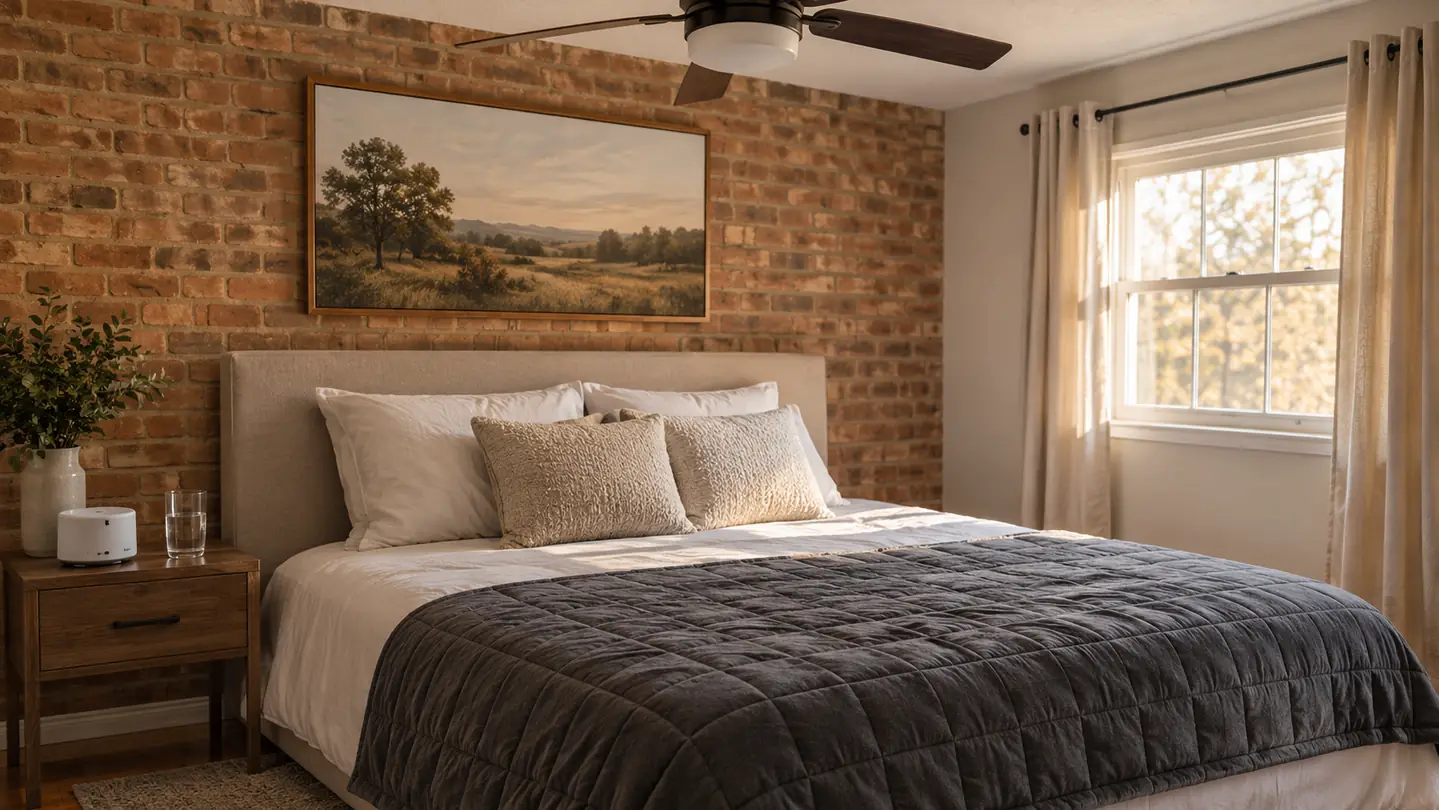
Short answer first, because I went looking for this exact comparison at one in the morning and every page I opened wanted to sell me something before it told me anything. A Topcee weighted blanket and a down comforter solve opposite problems. Down traps your body heat in a layer of lofted fill and keeps it there. The Topcee adds fifteen pounds of pressure without adding much warmth. If the thing waking you up is heat, the down comforter is the wrong tool and the weighted blanket is the better one. If the thing waking you up is cold, reverse that and go buy the comforter.
I am 53, I live in a one-story brick ranch in Chattanooga, and I have slept under a 15 lb Topcee weighted blanket since late August. I have also slept under my daughter Kayla's down comforter on visits, most recently in October. That is the only down comforter I have any real experience with, and I have never owned one myself. So that is the honest basis for everything below: about ten weeks under one, a handful of nights under the other, and a great deal of label reading.
| Topcee Weighted Blanket | Down Comforter | |
|---|---|---|
| Warmth | Light warmth. The listing describes the warmth level as lightweight, and what you feel is glass bead, not heat. | High warmth. Lofted fill traps body heat and holds it under the covers. |
| A warm bedroom | No loft to trap a pocket of air, so it does not build heat through the night. In July and August it was my only cover. | Can feel like too much by two in the morning, which is when most of the kicking off happens. |
| A cold bedroom | Not enough on its own. In November I put a light quilt over my feet. | Handles a cold room with no help at all. |
| Pressure and settling | Fifteen pounds of glass beads, sized for a 130 to 160 lb adult. It discourages the roll and the re-roll. | Light. It moves when you do. |
| Airflow | Breathable microfiber, but it is a solid layer sitting on the flat sheet. | Lofty, so air moves through it, but that same structure holds warm air against you. |
| Cleaning | Hand wash only. No duvet cover to strip and re-stuff every week. I spot clean and air it. | Usually lives inside a duvet cover, so you launder a large cover weekly, plus a careful wash for the comforter itself. |
| Fit on a full bed | 60 by 80 inches. It covers the sleeper, not the overhang, which is how weighted blankets are meant to fit. | Comes in bed sizes and drapes over the sides. The bed looks finished. |
| Fill and allergies | Glass bead fill, described in the listing as non-toxic and hypo-allergenic. No feathers. | Natural down. People who react usually react to dust in the bedding, but feather-sensitive sleepers do notice it. |
| Best for | A hot sleeper who still wants weight on top. | A cold sleeper, a cold room, or someone who wants a fluffy bed. |
How I Ended Up Comparing Them
I did not set out to write a comparison. I set out to stop waking at three in the morning with my sleep shirt stuck to my back, and the things I tried came in a fixed order: sheets in February, then a pillow in March, a white noise machine in April, a neck fan in June, and the weighted blanket last, in late August. One thing at a time, three or four weeks each, because that is the only way I can tell what actually did anything.
Before the Topcee, my cover was a heavy polyester comforter. It is folded in the hall closet now and I do not miss it. It was warm the way a coat is warm, which is the last thing I wanted at 51 when the flashes were at their worst, and it held the sweat instead of letting it dry.
The first night under the Topcee was a Sunday in late August, and I remember the date because of what woke me. It was 4:40 in the morning, still dark, and the first thing I noticed was that the flat sheet under me was dry. Not cool. Dry. I had been waking up damp for the better part of two years, so dry registered as an event worth noticing. The blanket had slid maybe six inches toward the foot of the bed, I pulled it back up, and I went back to sleep. With the old comforter that six inches of hauling would have been the end of my night, because by the time I had it back in place I was awake for good.
The down comforter enters the story because of my daughter. Kayla has one at her house, and I have slept under it on visits. It is the nicest thing I have ever pulled up to my chin, and it is also the reason I understood the difference in about four hours. Warm and light are not the same as cool and heavy, and I had been using those words as if they were.
Where Topcee Wins
The first win is the heat argument, and it wins it structurally rather than by marketing. Down works by trapping air in lofted clusters, and trapped air is insulation, which is exactly what you are trying to get away from at two in the morning. The Topcee has a soft breathable microfiber shell over glass beads. There is no loft to hold a pocket of body heat under your chin. In July and August it was my only cover, on top of a flat sheet, with the ceiling fan going, and I did not kick it off once.
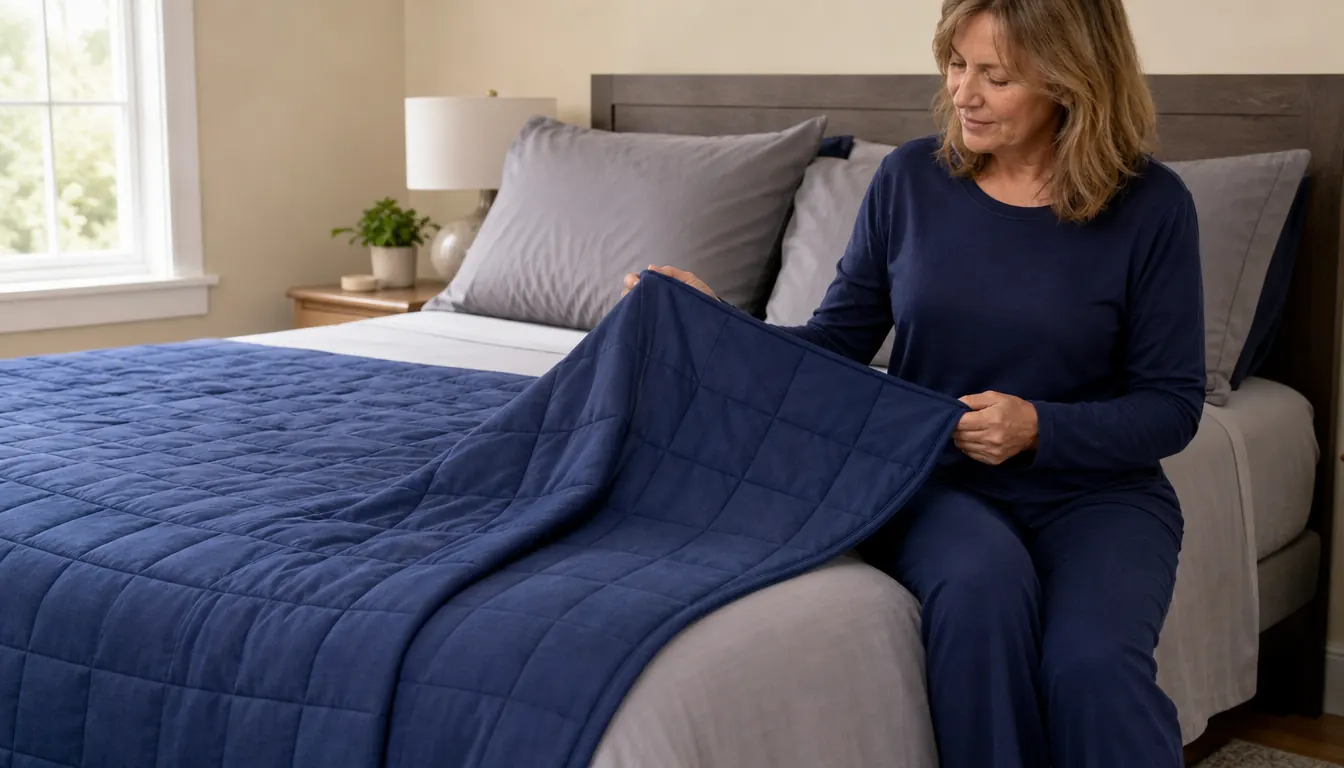
The second win is weight, and this is the part I did not expect to care about. I weigh about 150 pounds, so 15 lb was the size for me, and the listing puts that size at 130 to 160 lb of body weight. What fifteen pounds of glass bead does is settle. When I roll over, the blanket stays where I put it and then I stop rolling. At my worst I was waking three or four times a night, and a good share of those wakeups were me rearranging covers. Fewer covers to rearrange meant fewer reasons to be awake.
The sizing deserves a moment, because the listing asks you to pick 8 to 12 percent of your body weight, which is a range rather than an answer. I did the arithmetic twice on the back of a grocery receipt. Twelve percent of 150 is 18 lb and eight percent is 12 lb, so 15 lb sits near the middle of my range, and near the middle is where I wanted to be buying my first weighted blanket rather than the heaviest thing on the page. The fill is listed as 0.8 to 1 mm glass beads, and the listing describes positioning them so they do not all slide to one end. What that means on an ordinary night is that the blanket stays roughly even. If I fold it in half to carry it across the room, I can feel where the beads have gathered, and I shake it back out flat before I put it on the bed.
The third win is maintenance, and only because there is less of it. The listing says hand wash only, and I will not pretend that is convenient. But there is no duvet cover to strip, wash, dry and fight back onto a comforter every Sunday. I spot clean the Topcee, I aired it over the porch rail in September, and I hand washed it once in the bathtub, which took most of an afternoon and then two days drying flat on a sheet in the spare room. Annoying, done once, fine.
Fifteen pounds of glass bead settles. When I roll over, the blanket stays where I put it and then I stop rolling.
Where a Down Comforter Wins
Down wins warmth, and it wins by a wide margin. I slept under Kayla's in October in a house with the thermostat set lower than mine, and I was warm in a way the Topcee has never made me. Not hot, warm. There is a softness to down that no synthetic layer has matched in my hands, and it is genuinely light, which matters if you hate the feeling of being pinned down.
It also wins the way the bed looks and the way it covers. Kayla's comforter drapes over the sides of the mattress, and the bed looks made when it is made. My 60 by 80 inch Topcee sits on top of a full-size mattress and covers the sleeper, not the overhang, which is how weighted blankets are supposed to fit and also means my bed never looks quite finished. If you care about that, and plenty of people do, the down comforter is the prettier answer.
And in a genuinely cold room, down does the whole job alone. Mine does not. In November I have a light quilt folded over my feet, and I expect it there until March.
What Neither One Does
Neither blanket treats anything. I have talked to my doctor about where I am in this, and I am not going to use this page to hand out medical advice. A weighted blanket does not reduce hot flashes. A down comforter does not fix a cold bedroom. What they do is change how a night feels while you are lying in it, and for me the difference between a night I sleep through and a night I do not is usually made of several small comfort details rather than one big fix. If night sweats are new, severe, or getting worse, that is a conversation for your doctor rather than a bedding purchase.
One more thing they have in common: neither one is cold to the touch. I want to be clear about that, because the word cooling gets used loosely on listings. The Topcee does not make the bed cold. It simply does not hold heat the way my old comforter did. That is a smaller promise and a more honest one.
What I Liked
- Fifteen pounds of glass bead settle the covers, so you stop rearranging them at three in the morning
- No loft, so it does not build a pocket of body heat the way down does
- No duvet cover to strip, wash and re-stuff every week
- Sized by body weight, with a clear 130 to 160 lb range on the 15 lb listing
- Hypo-allergenic glass bead fill per the listing, with no feathers
Where It Falls Short
- Hand wash only, which means a bathtub afternoon and two days of flat drying
- Not warm enough alone in a cold room, so a light quilt goes over the feet from November
- Covers the sleeper, not the overhang, so a full bed never looks fully made
- Sixty by eighty inches is the Queen listing size and does not drape on a full mattress
If heat is what wakes you at two in the morning, this is the layer that does not hold it
15 lb, 60 by 80 inches, glass bead fill, hand wash only. This is the size I chose at about 150 pounds.
Amazon Check Today's Price on Amazon →The Washing Question, Since It Decides More Than You Think
I read the care instructions before I buy anything, and I nearly did not buy this because of them. Hand wash only is a real sentence, not a suggestion. Here is what it costs me: one afternoon in the bathtub with mild detergent and lukewarm water, pressing the water through instead of wringing it, then laying it flat on a sheet in the spare room for two days. The glass beads are the reason. A machine, even on gentle, is a gamble with the fill, and a blanket with a bead pile at one end is a blanket you have ruined.
The down comforter has its own version of this problem, and for a hot sleeper I would argue it is worse. Down usually lives inside a duvet cover, so you are laundering a large cover every week, and then the comforter itself wants either a big front-loading machine and a long tumble with dryer balls or a trip to a professional. When you are sweating most nights, the weekly part is the part that matters. The flat sheet under my Topcee takes most of the sweat, and the blanket itself gets spot cleaned. That suits me better than a weekly duvet cover wrestling match.
Spot cleaning is the actual routine, and it is simpler than the care label makes it sound. I keep a spray bottle of diluted mild detergent and a white cloth in the hall closet, next to the spare sleep shirt. When a flash wakes me and I sweat through the shirt, the shirt gets changed and the blanket gets a press with the damp cloth over that patch, then air. In a bad stretch that happens once a week. In a good stretch it happens once a fortnight and I do not think about it in between. The September morning on the porch rail was the closest thing this blanket gets to a proper freshening, and it came out smelling like nothing at all, which is what I wanted.
Who Should Buy Which
Buy the Topcee if you are the person I was in August: sleeping hot, waking up because you are rearranging covers, and not wanting a heavy layer of warmth on top of you. Buy it if you want weight without heat and you can live with hand washing. The listing asks for 8 to 12 percent of your body weight, so at about 150 pounds the 15 lb size landed inside that range, and it has been the right amount of pressure for me.
Buy the down comforter if you sleep cold, if your bedroom is cold, or if you want a bed that looks made and you do not mind a duvet cover in the wash every week. It is also the better choice if you share a bed with someone who runs colder than you do, because it is easy to push to one side and it does not press on anybody.
I did not buy both. I buy one thing at a time and try it for a few weeks, which is why the heavy polyester comforter is in the hall closet and the Topcee is on the bed. What that looks like in the second week of November, with the heat still off and the bedroom window cracked an inch because it faces east and warms up by nine in the morning: flat sheet, the Topcee on top of it, and a light quilt folded across the bottom third that covers my feet and nothing else. That is the entire setup. If I were starting over in a hot bedroom, I would buy the weighted blanket first and think about down in January, when the argument for warmth is easier to make.
The layer I actually sleep under in November, with a light quilt over my feet
60 by 80 inches, 15 lb, glass bead fill, hand wash only. Ten weeks in and it is still the only cover on the bed on warm nights.
Amazon Check Today's Price on Amazon →