
The pillow is the last thing anyone thinks about and the first thing you blame at 2 a.m. You flip it over looking for a cool patch and find the warm dent you left an hour ago. I did that flip three or four times a night for two years, from 51 into 52, back when the night sweats were at their worst. I kept a spare sleep shirt on the nightstand and a glass of water beside it, and I genuinely believed the problem was me and not the cheap pillow I had been sleeping on since before my divorce.
It was partly me. Menopause does what it does and no bedding on earth overrules it. But the pillow was making it worse. That flat polyester fiberfill number from a big-box store held heat like a brick left in the sun, and every flip bought me maybe eleven minutes of relief. In March I replaced it with a WEEKENDER cooling gel memory foam pillow, Queen size, and the flipping mostly stopped. Not because the pillow is cold. It is not. Because it lets go of the heat instead of storing it. That is a smaller claim than the packaging makes and a bigger difference than I expected.
Stop flipping. Start with a pillow that lets go of the heat.
Gel-infused memory foam with ventilation holes, five inches thick, Queen size, with a zippered polyester cover that goes in the washing machine. It ships compressed and needs a day or two to reach full height, so order it before the week you actually need it.
Amazon Check Today's Price on Amazon →Step 1: Start With a Pillow That Does Not Store Heat
Memory foam is wonderful at supporting your neck and terrible at letting go of body heat. Fiberfill is the opposite: it does not support much of anything, but it also does not press a warm shape back against your face. What I wanted was a pillow that supported like foam and behaved like something with air in it. The WEEKENDER is gel-infused memory foam with ventilation holes punched through it. Those holes are the part I care about. They give the warmth somewhere to go instead of parking it under your cheek until you flip. Before I spent anything I tried the free fixes first: a folded bath towel under the pillowcase, which was lumpy by midnight and warm by two, and a buckwheat pillow my daughter left at the house, which felt like sleeping on a bag of gravel. Neither one touched the actual problem, which was that the filling held every degree I put into it for eight hours.
The pillow is five inches thick, rectangular, Queen size, and weighs two pounds. Mine sits in a standard pillowcase without a fight. It has no cold side you can turn to, and it does not crinkle or rustle when you roll over, which matters more at 2 a.m. than I would have guessed when I was reading the listing.
Here is the honest version. The pillow is not cold at midnight. If you are hunting for something that feels refrigerated against your face, this is not that, and no foam pillow is. What it does is refuse to warm up under you the way the fiberfill one did. That is a smaller promise than the box makes, and it was enough for me.
Step 2: Give It Two Full Days Before You Decide Anything
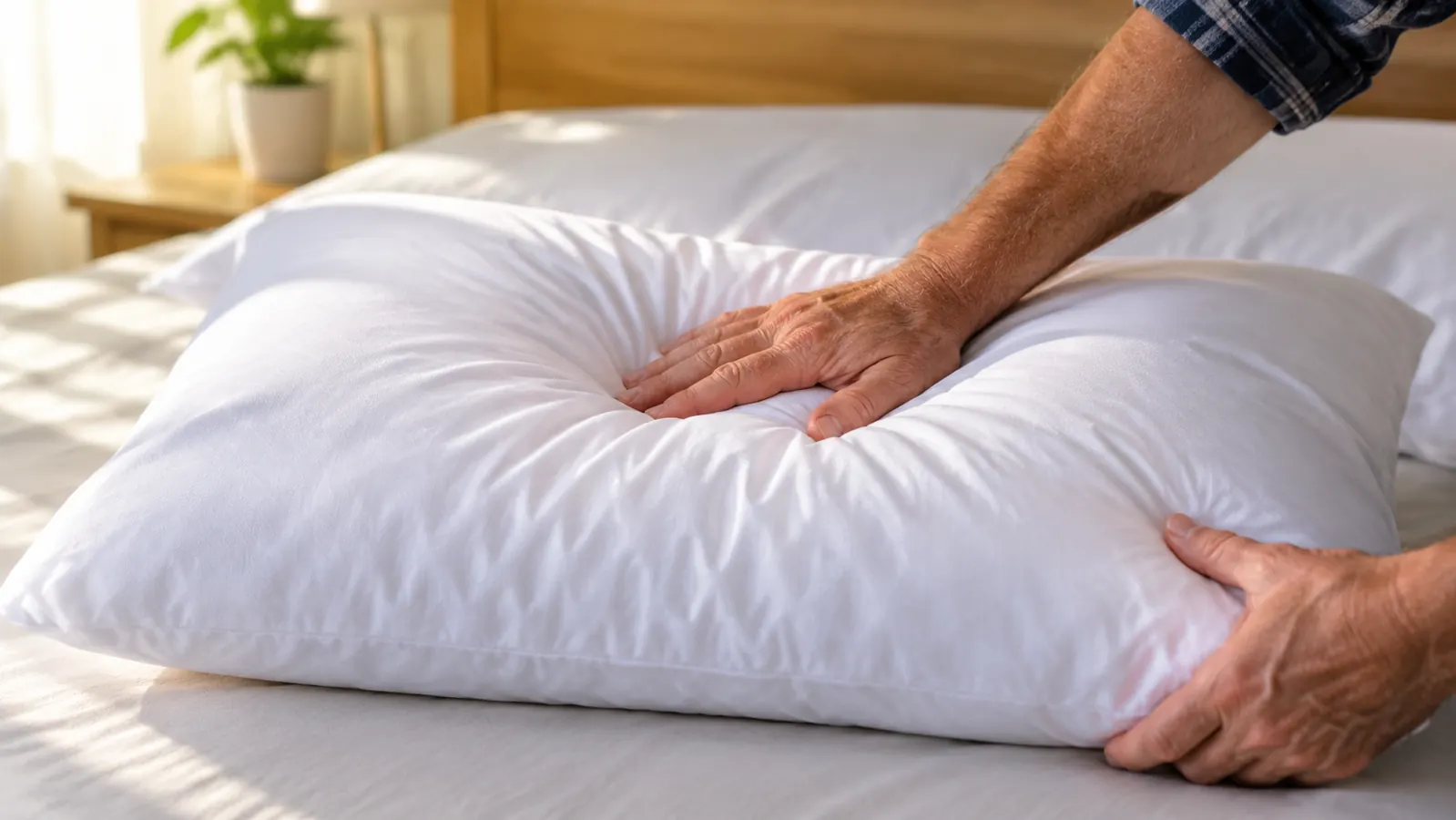
It arrives rolled and compressed and looking like a deflated couch cushion. Unbox it, take the plastic off, and leave it alone for 24 to 48 hours. Mine took about two days to reach full height. The first night it was maybe three inches thick, and I had already decided in my head that I had wasted my money.
Do not judge it on night one. Do not judge it on night two either, honestly. Give it the full two days on the bed, at room temperature, with nothing stacked on top of it. Then sleep on it for a night and see what your neck says in the morning, because your neck is the part that files the real review.
By the third night mine had firmed up into something with genuine support, and the difference in how warm my face felt was obvious within an hour. The old pillow had been a warm spot with a pillowcase on it. This one stayed neutral from lights out until about 4 a.m., which is a strange thing to be grateful for and I am anyway. I marked the date on the kitchen calendar, March 14, because I am the sort of person who marks things on the calendar. By the 16th it measured a full five inches at the center with a ruler held against the side, and it has stayed there through seven months of nightly use.
Step 3: Put a Washable Cover Between You and the Foam
The WEEKENDER comes with a zippered polyester cover that goes in the washing machine and the dryer. I unzip it every Sunday when I strip the bed, wash it with the sheets, and put it back on. The foam core does not go in the machine. Only the cover does. A cover you can genuinely wash once a week matters more to me than any word printed on the packaging. Sunday is the wash day in this house and always has been. Cover off, in with the sheets on cold, tumble low, back on the pillow before lunch. If the weather is decent I set the bare foam core on the porch rail for an hour to air, which the manufacturer does not ask for and which makes me feel better anyway.
Over the cover I use a regular pillowcase, the 20 by 30 ones that came with my sheet set. The fabric is smooth and does not cling when I sweat, which sounds like a small thing until you have woken up with a damp pillowcase stuck to your face at three in the morning. I keep the second pillowcase in the linen closet and swap it midweek if it has been a rough stretch of nights.
Neither the cover nor the pillowcase is a cooling product. They are dry products. The point is to keep a clean, dry layer between me and the foam so the ventilation holes are not sealed under damp cloth, which is exactly what a sweaty pillowcase does by the middle of the night.
The pillow is not cold. It just does not hold heat the way the old one did, and that turned out to be the difference between three wake-ups a night and one.
Step 4: Move the Air Around the Pillow, Not Just the Room
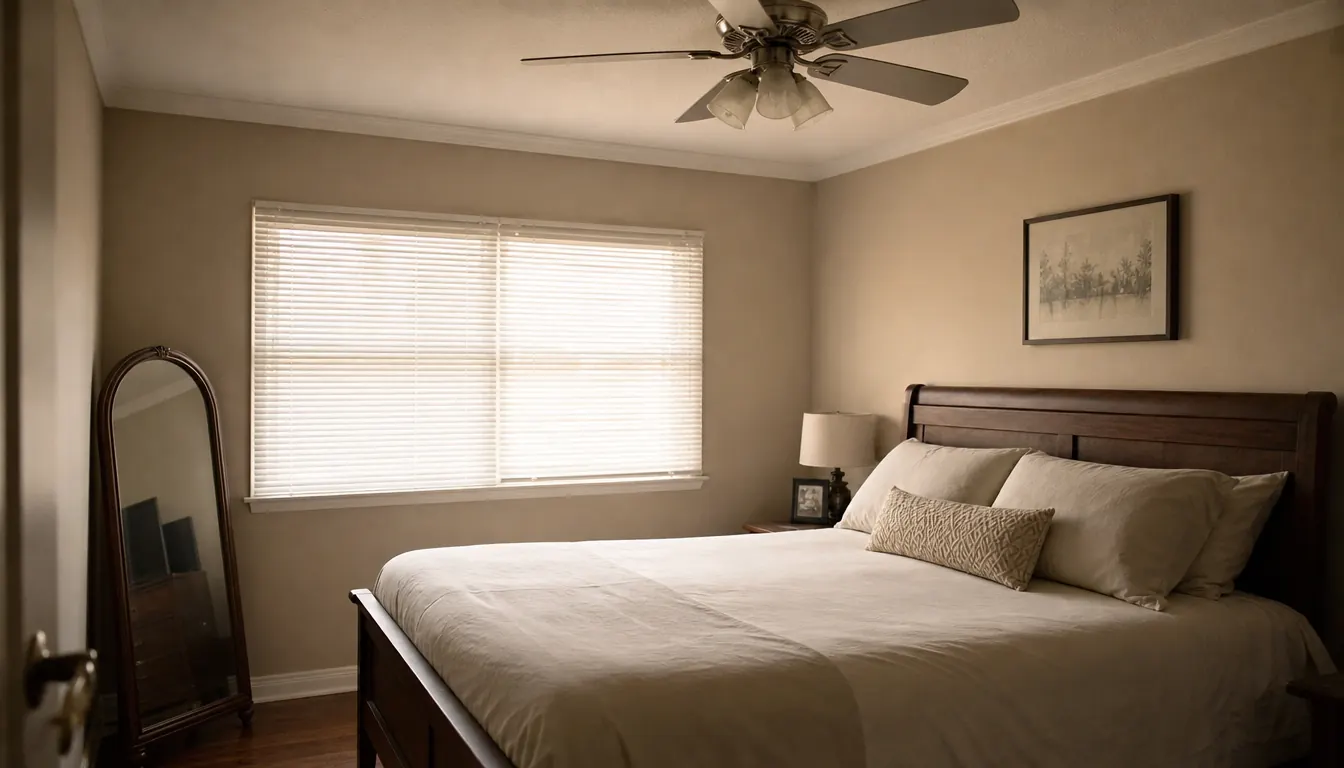
A pillow cannot cool air that is not moving. My bedroom is the back room of a one-story brick ranch and it faces east, so it holds the afternoon heat and then takes the morning sun anyway. The central air sits at 72 because of the power bill. The ceiling fan was already there. I run it on low to medium, pulling air up rather than blasting down on me, and that alone changed how the pillow felt by midnight. That fan is a plain three-speed pull chain model that came with the house. I use the middle pull from May through October and keep it pulling air up, because a direct draft on my face feels good for about four minutes and then my eyes are dry. The room air still turns over, and more to the point the pillow is not sitting in a pocket of still, warm air.
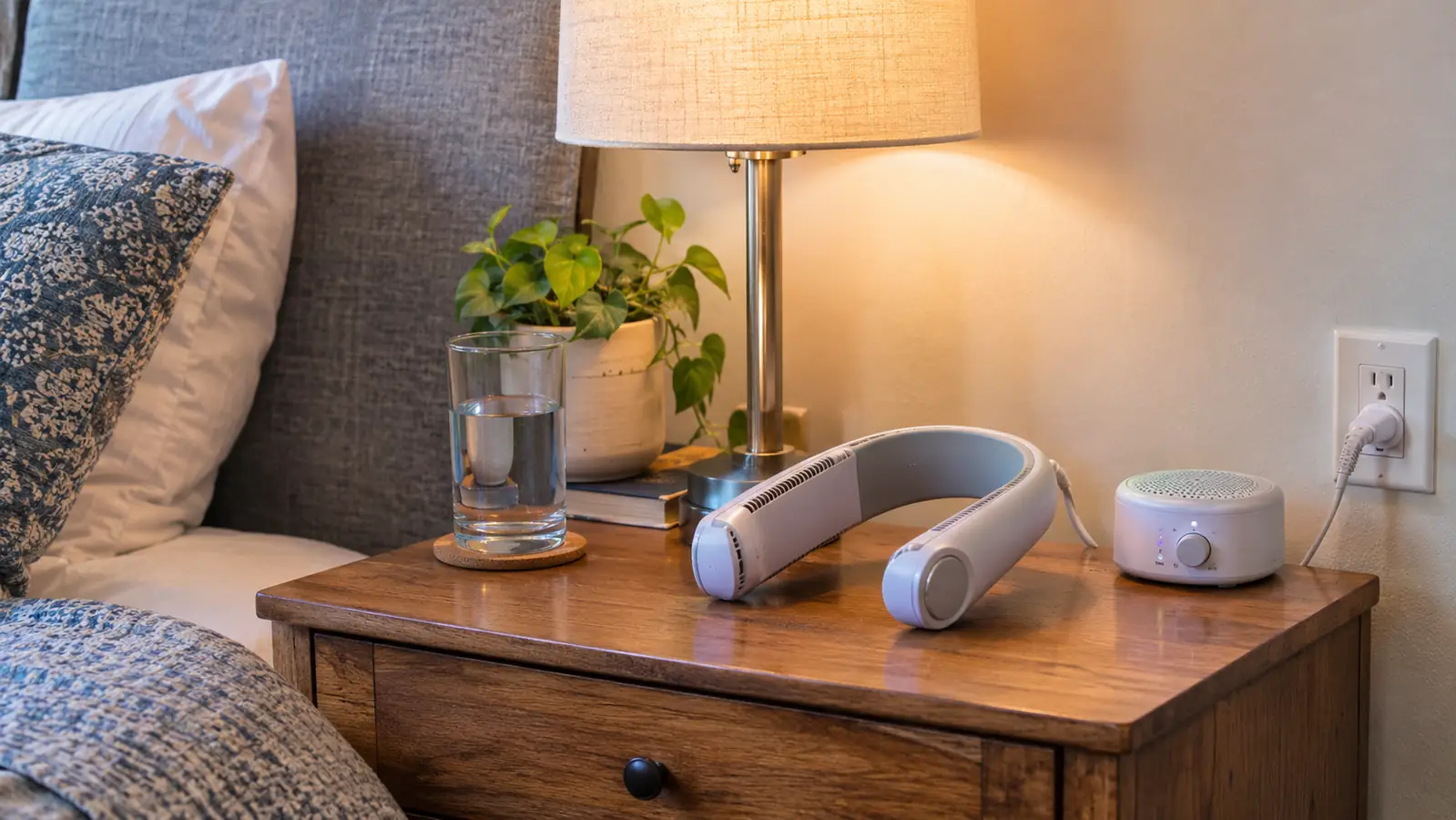
The other fan is a JISULIFE neck fan that lives on the nightstand, not on me. It is bladeless, has five speeds, and charges by USB-C; I top it up every few days. When a flash wakes me, I sit up on the edge of the bed, put it on a middle speed for ten or fifteen minutes, then take it off and lie back down. I also wear it while reading before lights out on the hot nights in June and July. I have never slept wearing it. That seemed like a fine way to strangle myself in my sleep.
One thing that did not work: putting the pillowcase in the freezer for ten minutes before bed. It felt lovely for about twelve minutes, and then I had a room-temperature pillowcase on a warm pillow. The cold has to come from somewhere all night, and the freezer is down the hall.
Step 5: Handle the Wake-Up Without Reheating Everything
This is the step that actually gets me back to sleep. When I wake at 3 a.m. in a flash, my old habit was to thrash: flip the pillow, kick the sheet off, flip the pillow back, huff. Thrashing heats the bed up and hands you a second hot flash for free. Now I sit up, put the neck fan on for ten minutes, and let the sweat dry. I keep a spare sleep shirt on the nightstand and change it if I need to. Then I lie back down on the same pillow, which has not spent ten minutes absorbing the side of my face. Two things make the routine work. I do not turn on a light, and I do not check the clock, because knowing it is 3:40 and I have to be up at 6:15 is its own kind of hot flash.
The white noise machine is a Magicteam with 20 non-looping sounds, 32 volume levels and a timer, plugged into the wall on the nightstand. I use the brown noise setting, low to middle volume, timer off so it runs all night. It does nothing for temperature. What it does is cover the neighbor's dog, the garbage truck at 5:40, and the click of the central air kicking on, which used to be enough to finish the job of waking me up.
Two years ago I was waking three or four times a night. Now it is more often one, sometimes two, and I am back asleep inside ten minutes on most nights. I still have flashes most nights. That part has not changed. What changed is how much of the night they get to eat.
What Else Helps
The pillow sits in a bed, and a hot bed undoes a good pillow. My sheets are a double-brushed microfiber set with a 14 inch fitted pocket, one set only, washed weekly on cold and tumbled low. They feel smooth and they do not cling when I sweat. They also do not make the bed cold, and I want to be clear about that. No sheet does that. What they do is dry fast and stay smooth, and smooth is what you want at 3 a.m.
Cotton percale is the other thing people bring up, and I know it from hotel rooms rather than from owning it. It has a crisper, cooler hand when you first get in. I have not bought a set, because I buy one thing at a time and the microfiber set was the cheapest thing to try back in February. If I were starting over in a hot climate with a bigger budget, I would look at percale before anything else.
Since late August I have been under a 15 pound cooling weighted blanket, 60 by 80, polyester microfiber shell, glass bead fill, hand wash only. I weigh about 150 pounds, which is why I picked 15. In summer it was my only cover; now in November I put a light quilt over my feet. It is not cold and it does not breathe like a sheet. What it does is stop the tossing, and a still body heats a pillow a great deal less than a restless one.
The last thing, and it is the thing I would say to any woman in this stretch of life: the bedding is comfort, not treatment. Talk to your doctor about the flashes themselves. What all of this buys you is a bed that is easier to get back into at 3 a.m., and on a bad night that is worth more than it sounds.
The first thing I would buy again, in this order or any other.
Five inches of gel-infused memory foam with ventilation holes, a zippered cover that goes in the wash, Queen size. Mine took two days to expand in March and I have slept on it every night since.
Amazon See the WEEKENDER Pillow on Amazon →